

January 21, 2025
|
in Criminal Law
by Dr. Anthea Pitschel
Drunk Driving – The Essentials at a Glance
- In the case of drunk driving (§ 316 StGB), anyone who operates a vehicle in public traffic while they are unfit to drive due to alcohol or other intoxicants is liable to prosecution. A conviction is possible even without an accident or specific endangerment. The decisive factors are:
- Vehicle: This includes not only cars and motorcycles, but also e-scooters, e-bikes, and bicycles, among others.
- Unfitness to drive: Case law distinguishes between absolute and relative unfitness to drive.
- Alcohol limits: Car / Motorcycle / E-scooter: absolute unfitness to drive from 1.1 ‰ Bicycle: absolute unfitness to drive from 1.6 ‰ relative unfitness to drive: from 0.3 ‰ in connection with alcohol-related abnormalities. In addition to the penalty, there is a regular threat of seizure of the driver’s license after drunk driving, the revocation of the driving license, and a suspension period. Even first-time offenders are not exempt from this.
Accusation of Drunk Driving (§ 316 StGB)
One beer in the evening or a glass of wine in a social setting can quickly turn into several. Many people eventually face one of the following questions:
- “I’ve had two beers – am I still allowed to drive?”
- “I’m a first-time offender – what are the consequences of drunk driving?”
- “Does this also apply to bicycles or e-scooters?”
- “The police have seized my driver’s license – what does that mean for me?”
For all these situations, the criminal offense of drunk driving according to § 316 StGB is decisive. Drunk driving is not a trivial offense, but a criminal matter with possible consequences for freedom, money, and driving privileges. If you have received a police summons or a penal order for drunk driving, the following applies: stay calm, do not make any statements on the matter, and seek legal assistance early on. As an accused person, you are not obliged to appear at the police station or to comment on the allegations.
Intentional and Negligent Drunk Driving
§ 316 Para. 1 StGB covers intentional drunk driving. Intent exists if the driver knows or at least accepts that they are no longer fit to drive due to alcohol or other intoxicants and drives anyway. Many accused report that they felt “still fit to drive” or had “only drunk a little.” However, a mistake about one’s own unfitness to drive does not automatically lead to immunity from prosecution, but it can mean that no intent, but only negligence exists. This is covered separately in § 316 Para. 2 StGB and is usually punished more leniently. In practice, there is often a dispute as to whether drunk driving was committed intentionally or negligently. Courts sometimes quickly infer intent from high blood alcohol levels. However, the per mille value alone is not sufficient for this. It always depends on the individual case: personality and drinking habits, type and timing of alcohol consumption, the situation when starting the journey, and the external course of the journey. This is precisely where a specialist lawyer for criminal law can intervene to enforce a negligent instead of intentional drunk driving charge in the interest of the client – with significantly more favorable consequences for the sentence.
The Offense – When does drunk driving occur?
The objective elements of § 316 StGB first require that a vehicle is operated in public traffic. Operating means setting the vehicle in motion independently or steering it during the journey. Not every action on the vehicle is sufficient: simply starting the engine or releasing the brake without driving off does not yet fulfill the offense. Whether “operating” already exists must therefore always be assessed on the basis of the specific individual case. The term vehicle includes:
- Motor vehicles such as cars, trucks, motorcycles
- E-scooters, e-bikes, and certain pedelecs
- Non-motorized vehicles such as bicycles
- Watercraft and rail vehicles
In-line skates or skateboards, for example, are not included. Public traffic is open if the traffic area is fundamentally accessible to everyone or an indefinite group of people. This is the case with roads, public parking lots, or freely accessible company premises. Purely private areas to which only a strictly limited group of people has access are not included.
Unfitness to Drive – The Core of Drunk Driving
Drunk driving requires that the driver, as a result of the consumption of alcohol or other intoxicants, is no longer able to drive the vehicle safely. This refers to the overall traffic-specific performance: reaction time, concentration, orientation, judgment, and emotional control. If these abilities are significantly reduced, there is unfitness to drive.
Alcohol-related Unfitness to Drive
Alcohol typically leads to an overestimation of one’s own performance, while reaction time, attention, and coordination decrease. How strongly this affects a person depends on many factors: the amount and course of drinking, body weight, habituation, and individual constitution. In case law, empirical values have emerged that play a major role in practice:
- Absolute Unfitness to Drive For motor vehicles – and e-scooters, which are treated as equivalent by the Federal Court of Justice – the following applies: From 1.1 ‰ BAC, it is irrefutably presumed that the driver was unfit to drive. Further abnormalities then no longer need to be proven. For cyclists, case law assumes absolute unfitness to drive at 1.6 ‰ BAC.
- Relative Unfitness to Drive If the blood alcohol level is lower, a punishable drunk driving offense can still exist if so-called alcohol-related failures are added. As a guideline: From 0.3 ‰ and clear abnormalities (weaving, red light violations, accident, loss of control over the vehicle), the court can assume relative unfitness to drive.
Unfitness to Drive due to Drugs or Medication
§ 316 StGB covers not only alcohol, but also other intoxicants such as narcotics or certain medications. Unlike alcohol, there are no fixed per mille or active substance limits here. The decisive factor is whether the substance is detectable and has led to a relevant restriction of driving safety. The courts evaluate the type and amount of the active substance, the time interval to the journey, the driving behavior, and the physical and mental abnormalities of the driver. The higher the detected concentration of the active substance, the lower the requirements placed on specific driving errors.
Drunk Driving with a Car, Bicycle, and E-Scooter
Daily practice shows that drunk driving no longer only concerns “classic” car trips after a visit to a pub.
Drunk Driving with a Car
The typical drunk driving offense involves operating a car after consuming alcohol. Whether it comes to a check during a police stop, an accident, or a conspicuous driving style – if unfitness to drive is determined, the following are threatened:
- Criminal proceedings according to § 316 StGB,
- Seizure and subsequent revocation of the driving license,
- A fine or – in the case of prior convictions or accidents – imprisonment.
It becomes particularly critical in the case of drunk driving with an accident. Here, endangering road traffic (§ 315c StGB) or other offenses may also be involved, which can lead to a significantly higher sentence and a longer suspension period.
Drunk Driving with a Bicycle
Many underestimate that drunk driving with a bicycle can also be a criminal offense. If a cyclist is found to have a BAC of 1.6 ‰ or more, case law assumes absolute unfitness to drive. The consequences are serious:
- Criminal proceedings for drunk driving,
- Regular order of a medical-psychological examination (MPU),
- Risk of revocation of the driving license – including the motor vehicle license, even though “only” a bicycle was ridden.
Especially for first-time offenders in the case of drunk driving with a bicycle, it often comes as a surprise that the entire area of driving aptitude is put to the test.
Drunk Driving with an E-Scooter
E-scooters are largely treated like motor vehicles under criminal law. This means:
- The same alcohol limits as for cars,
- The same classification of unfitness to drive,
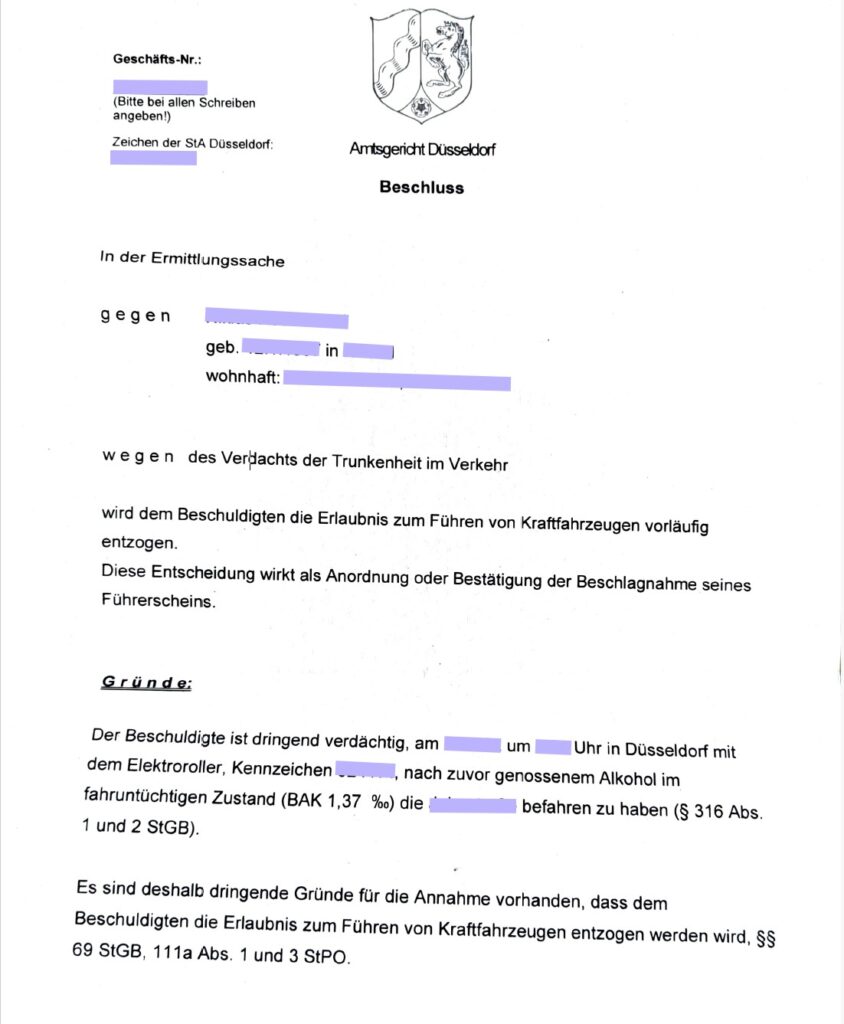
- Regularly the same consequences for the driver’s license: revocation of the driving license according to § 69 StGB.
In many cases, e-scooters are used because people want to avoid driving a car while drunk. Many are not aware that drunk driving with an e-scooter is evaluated legally in almost the same way as with a car. Here, too, it may be possible for first-time offenders who only wanted to cover a short distance to assert mitigating circumstances in individual cases – but this requires a targeted defense strategy.
Seizure and Revocation of the Driver’s License after Drunk Driving
In practice, many accused experience that the driver’s license is seized right on the spot. According to § 111a StPO, the police can provisionally revoke the driving license if there are urgent reasons to assume that the court will later revoke the driving license. From this point on, you are no longer allowed to operate a motor vehicle – even if no judgment has yet been reached. In the judgment or penal order, the following is then threatened:
- The revocation of the driving license according to § 69 StGB and
- The setting of a suspension period according to § 69a StGB, during which no new driving license may be issued.
The suspension period can be between six months and five years, and in particularly serious cases even longer. For first-time offenders and lower alcohol levels, a shorter suspension period is possible, while repeat offenders must regularly expect longer suspension periods. Even with a foreign driver’s license, the driving license authority can block use within the federal territory and take the license into temporary custody.
Shortening the Suspension Period after Drunk Driving
In suitable cases, a shortened suspension period can be achieved, for example if:
- You have no criminal record and it is a one-time offense,
- There was no endangerment of other road users and no accident,
- Professional or existential disadvantages are particularly severe,
- You have participated in traffic psychology measures or courses.
Whether an application for shortening the suspension period after drunk driving has a prospect of success should always be checked on a case-by-case basis. Here, it can be useful to set the course accordingly early in the proceedings.
Sentencing for Drunk Driving
The statutory sentence for drunk driving is regulated in § 316 StGB. For both intentional and negligent drunk driving, the range extends from a fine to one year of imprisonment. In practice, the specific sentence depends on numerous factors:
- Level of blood alcohol concentration,
- Involvement in an accident and any personal injury,
- Prior convictions and earlier traffic offenses,
- Professional situation and dependence on the driving license,
- Behavior after the act (e.g., remorse, restitution).
It should be noted that a fine of more than 90 daily rates or a prison sentence of more than three months regularly leads to an entry in the certificate of conduct, provided that no other entries already exist. This can be of significant weight, particularly with regard to employers and professional licenses.
How should I behave during a traffic stop after consuming alcohol?
If I get into a police stop after consuming alcohol, many spontaneously ask the question: “What must I do – and what is better not to do?” You are obliged to:
- Provide your personal details and
- Tolerate measures such as a blood sample if ordered.
You are not obliged to:
- Blow into a breathalyzer,
- Provide voluntary urine or saliva samples,
- Participate in physical tests (e.g., walking in a straight line, finger-to-nose test), or
- Provide information on the amount drunk, drinking time, route driven, or consumption behavior.
The principle is: You do not have to actively contribute to your own conviction. Every additional detail can later be used as evidence against you. Restraint and silence are therefore usually the best option until you have sought legal advice.
Do I need a lawyer for drunk driving?
Criminal proceedings for drunk driving rarely concern only “that one evening,” but regularly involve:
- Your driving license,
- Your professional perspective,
- Possible MPU requirements, and
- Your criminal record and certificate of conduct situation.
At the latest when you have received a summons as an accused, a penal order, or a notification about the seizure of your driver’s license, you should contact a specialized criminal defense lawyer. They can request access to the files, check the evidence, legally evaluate the question of intent or negligence, and develop a strategy with you – for example, to avoid an entry in the certificate of conduct or to reduce the suspension period.
Are you facing an accusation of drunk driving?
We have extensive experience in traffic criminal law and defense in drunk driving cases – whether by car, bicycle, or e-scooter. We accompany you through the entire process and support you in keeping the consequences of drunk driving as low as possible.
Consultation via Video Conference
Our attorneys provide personal consultations regardless of your location – via secure video conferencing, throughout Germany.
Schedule an Appointment
Ihr Kontakt zu uns
Schildern Sie uns Ihren Fall vertraulich
Schildern Sie kurz, was passiert ist und ob Fristen oder Termine laufen. Wir melden uns in der Regel innerhalb von 24 Stunden, um das weitere Vorgehen und die benötigten Unterlagen zu klären.
Call directly