
Defense Under Section 261 StGB

When accounts, transactions, or assets suddenly become part of criminal proceedings, a precise analysis of financial flows is essential. We provide nationwide criminal defense against money laundering charges.
Defense Against Money Laundering Allegations
Separately Evaluating Origin, Action, and Knowledge
Allegations of money laundering frequently arise from unusual account activity, cash transactions, corporate payments, crypto transfers, or the suspicion that assets stem from an unlawful act. Even at an early stage, frozen accounts, asset seizures, or search warrants can lead to severe consequences.
Section 261 StGB covers various forms of dealing with assets derived from unlawful acts. For your defense, everything depends on whether the origin can be proven, which specific conduct is attributed to you, and whether intent—or, in cases recognized by statute, gross recklessness—was present.
Do not make spontaneous statements regarding payments, accounts, wallets, or business partners. We request access to the investigative case files and reconstruct the transactions based on the official evidence.
Proven Professional Experience
Complex proceedings demand proven experience and specialized expertise. That is why we feature only awards and credentials that are current and verifiable.
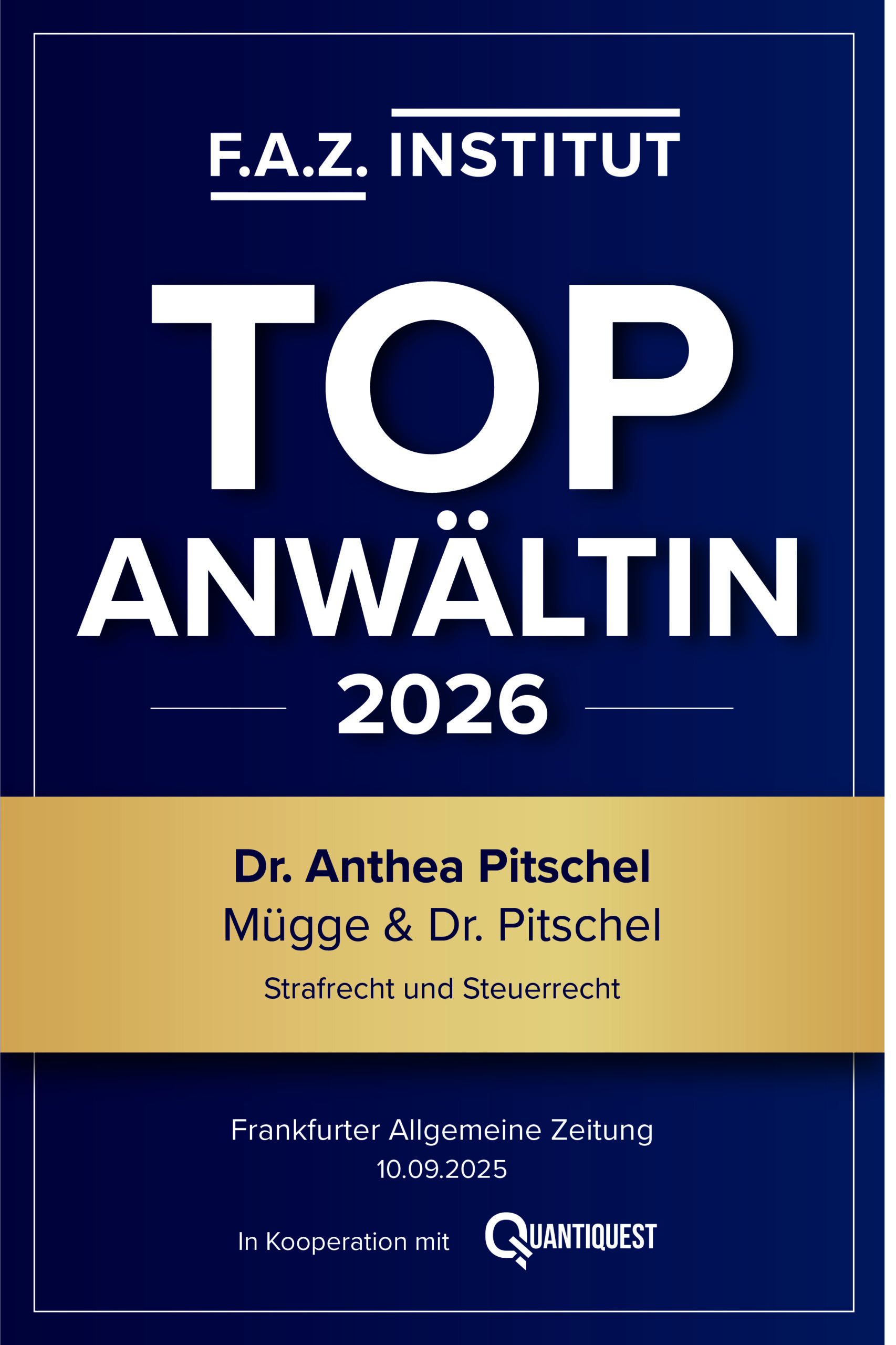
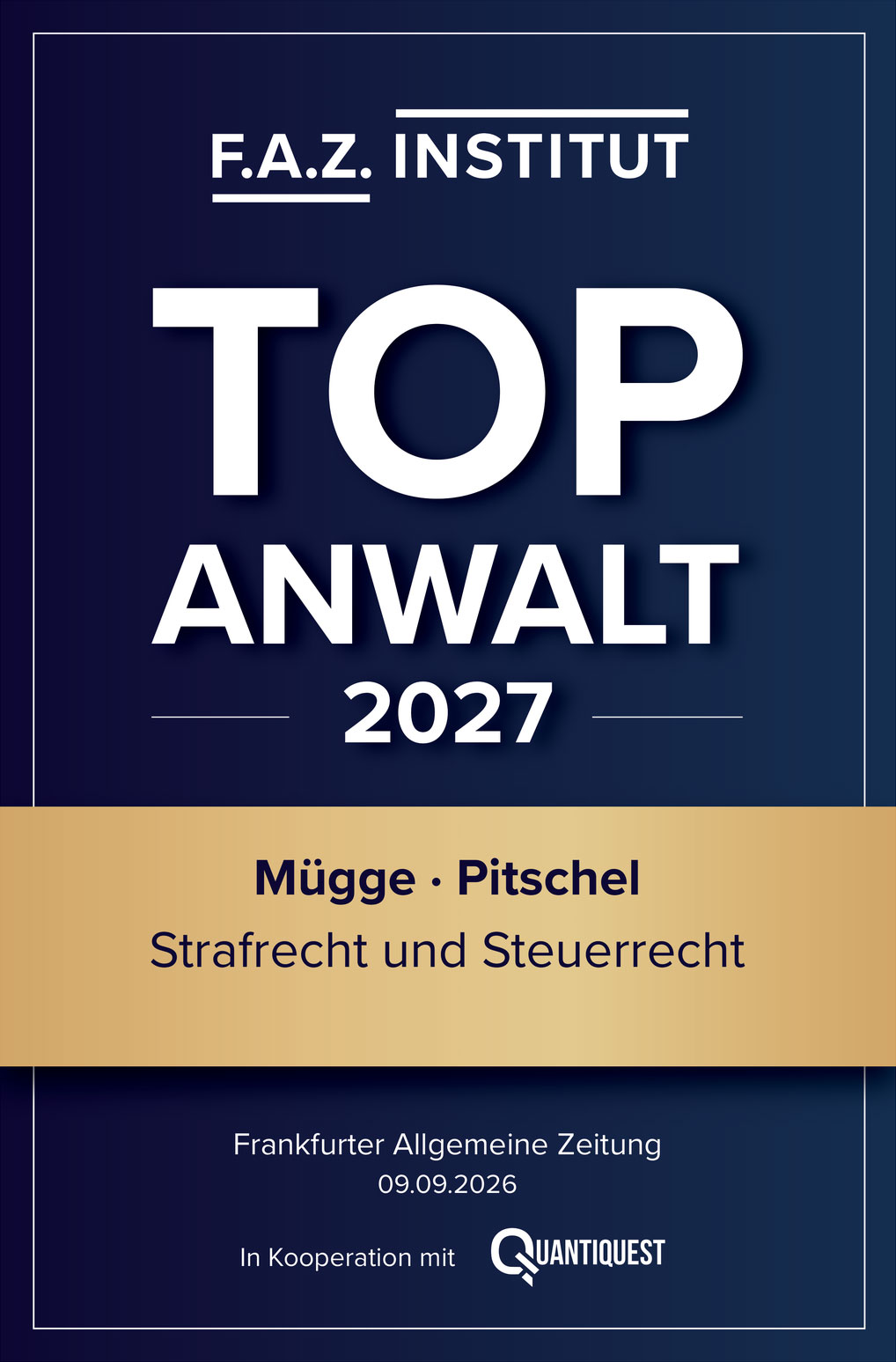
 TOP Lawyer 2026 & 2027 for Criminal Law and Tax Law
- Certified Specialist Attorneys for Criminal Law and Tax Law
- Certified Consultants for Criminal Tax Law and White-Collar Criminal Law (DAA)
What Matters Now
First Steps When Accused of Money Laundering
Secure all correspondence from the police, public prosecutor’s office, banks, or courts, along with bank statements, contracts, and transaction records.
A frozen account or an asset seizure is not the same as a conviction. The court order, the secured amount, and the legal allocation of assets must be evaluated independently.

Do not make uncoordinated statements regarding the allegations
Do not delete records or prematurely transfer funds
Secure bank statements, contracts, and receipts
Have frozen accounts and asset seizures reviewed immediately
Key Considerations
What Defense Counsel Examines
A suspicious transaction alone does not prove money laundering.

Origin and Predicate Offense
Which unlawful act is being alleged, and is the origin of the specific asset verifiable and substantiated?
Accounts and Transactions
We reconstruct incoming and outgoing payments, commercial background, contracts, and consideration.

Knowledge or Recklessness
What information was available? Was the unlawful origin known, or was there gross recklessness in failing to recognize it? We examine these legal requirements based on the specific circumstances.

Financial Agent or Third-Party Account
Deliberate involvement, recklessness, or the victim of a fraudulent scheme? Your actual role must be clearly delineated.

Searches and Crypto
Scrutinizing Data Analysis and Wallet Attribution
During residential searches, account queries, or seizures, authorities often analyze extensive volumes of data. We review the legality of the measure and the attribution of documents, devices, and assets.
Crypto transactions can be traced, but they are not self-explanatory. Wallet attribution, exchange accounts, transaction history, and commercial purpose must be accurately reconstructed.
How We Assist You
Defense Under Section 261 StGB—From Initial Suspicion to Final Resolution
We request access to investigative files, reconstruct payment flows, examine alleged predicate offenses and subjective knowledge, and simultaneously defend against asset-freezing measures.
01
Clarifying Origin
We examine which offense is alleged as the predicate crime and whether the specific asset can legally and factually be attributed to it.
02
Reconstructing Financial Flows
Accounts, cash, contracts, invoices, wallets, and communication data are reconstructed chronologically and economically.
03
Evaluating Knowledge and Intent
We assess whether intent or gross recklessness can be substantiated by the evidence.
04
Challenging Asset Measures
We independently challenge asset seizures, frozen accounts, and confiscation orders whenever the scope, attribution, or statutory requirements lack legal merit.

Legal Framework
Origin, Actus Reus, and Subjective Knowledge Are Decisive
Section 261 StGB criminalizes various acts involving assets derived from an unlawful act. These include, among others, concealing, certain transfer or exchange actions, procuring, as well as custody or use. Obscuring relevant facts can also be covered under the statute.
The basic offense carries a prison sentence of up to five years or a fine. Especially serious cases may carry higher penalties under Section 261 (5) StGB; Section 261 (6) StGB penalizes grossly reckless failure to recognize the asset’s origin in certain scenarios.
Scenarios and Key Legal Questions
Typical Scenarios in Money Laundering Allegations
The common denominator is whether an unlawful origin and criminal conduct in handling the assets can actually be proven.
Accounts and Wire Transfers
Where do the funds originate? What consideration or commercial purpose underlies the payment?
Cash and Assets
How were acquisition, possession, and origin documented? To which person is the asset commercially attributable?
Corporate Payments
Which contracts, invoices, and services account for the transaction? Who was internally responsible?
Financial Agent or Third-Party Account
What communications took place? What did the account holder know about the sender, recipient, and purpose?
Crypto and Wallets
To whom is the wallet attributable? Which exchange accounts, transaction paths, and background factors exist?
Asset Seizure and Frozen Accounts
What amount and which assets are affected? Does the legal basis for asset confiscation hold up?

Involvement of Crypto or Corporate Entities?
Money laundering allegations are often connected to crypto assets or white-collar criminal proceedings. Learn more on our pages dedicated to crypto criminal defense and corporate defense.

Your Legal Contacts
Your Defense Team
Our certified advisors for corporate criminal law (DAA) combine corporate, tax, and general criminal law expertise, intervening early to defend against asset-freezing measures.
Meet Our Team






Benienja Kirschbaum
Office Management

Carolina Mügge
PA to CEO
Client Testimonials










Frequently Asked Questions About Money Laundering Allegations
Money Laundering Under Section 261 StGB
Confidential Initial Inquiry
Tell Us About Your Case
Briefly describe which authority is investigating, what measures have already been taken, and whether you have bank records, court orders, or a summons. We will evaluate the next steps confidentially.
Call directly