

November 2, 2024
|
in Criminal Law
by Dr. Anthea Pitschel
Key Facts Regarding the Allegation of Assault
- Various Degrees of Severity: Assault can be prosecuted as simple, dangerous, or serious assault—depending on the circumstances and consequences.
- Sentencing: Penalties range from fines to imprisonment for several years, depending on the severity of the act.
- Right to Defense: You are not required to make a statement to the police and should contact a lawyer immediately upon receiving a summons.
- Objection Period: In cases of serious assault allegations, you are entitled to a court-appointed defense counsel—legal assistance is essential here.
How to behave when facing an allegation of assault?
Whether as a politician putting up campaign posters, a professional athlete in a relationship dispute, or a professor at the University of Göttingen who regularly beat his doctoral student with a bamboo stick: Assaults are omnipresent and occur in a wide variety of forms.
Should you be involved in an allegation of assault, this article can serve as a legal overview and a guide for the steps that should reasonably be taken.

If you have received a police summons for assault under § 223 StGB, dangerous assault under § 224 StGB, serious assault under § 226 StGB, or negligent assault under § 229 StGB, the following is initially advisable:
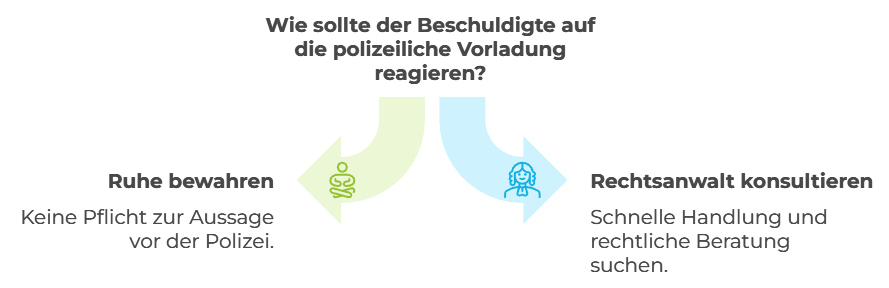
Try to remain calm. As a defendant in an investigation for assault, you are not obliged to provide information to the police.
The potential sentence varies considerably depending on the specific assault offense. Therefore, you are nevertheless advised to act quickly and seek advice from a lawyer familiar with assault offenses.
When are the elements of § 223 StGB met?
Objectively, the elements of assault under § 223 StGB are met if you have physically abused another person or caused damage to their health.
The outcome of physical abuse occurs when there is ill, inappropriate treatment that impairs physical well-being or physical integrity in a more than insignificant way.
Damage to health is understood as any causing or increasing of a pathological condition of a physical or psychological nature. A sensation of pain is not a statutory requirement for either alternative.
There must be causality between the act and the outcome of physical abuse or damage to health, and the outcome must be objectively attributable to human behavior. The latter can be understood as a correction based on evaluative criteria and is assumed if the behavior created a legally disapproved risk of the outcome occurring and this risk actually materialized in a specific event causing the outcome.
Subjectively, assault under § 223 StGB requires intentional behavior.
Intentional assault is a relative offense prosecutable only upon request. Prosecution therefore takes place upon request, or if the prosecution authority considers intervention necessary due to the special public interest in criminal defense.
If you also take a third-party movable object as part of an act of assault, this can be classified as robbery under § 249 StGB—especially if you use violence specifically to enable or secure the taking.
Dangerous assault under § 224 StGB – A qualifying offense
In the event of aggravating objective circumstances, to which the intent must also extend subjectively, the criminal offense of dangerous assault under § 224 StGB provides for a significantly higher sentencing range compared to § 223 StGB.
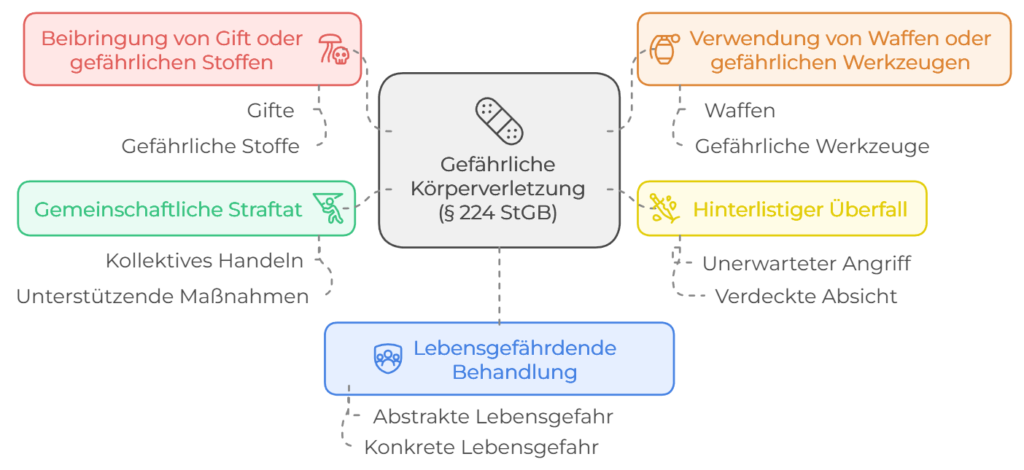
These objective circumstances are enumeratively listed in § 224 StGB. Accordingly, dangerous assault includes assault by administration of poison or dangerous substances (No. 1), by means of a weapon or another dangerous tool (No. 2), a treacherous ambush (No. 3), jointly with another participant (No. 4), or by means of treatment that endangers life (No. 5).
As one of the particularly dangerous methods of commission, § 224 Para. 1 No. 1 StGB names the administration of poison or other substances harmful to health.
“Poison” includes any organic or inorganic substance that, under certain conditions, is capable of causing serious damage to health through chemical or chemo-physical action. The definition is based on the type of substance and the amount used by the perpetrator in the specific case. For classification as poison, it is irrelevant whether the substance is commonly used in everyday life; the only decisive factor is whether there is a threat of significant damage to health. For example, a heavily salted pudding can be classified as poison due to the risk of salt poisoning.
As a catch-all provision, “other substances harmful to health” supplement the characteristic “poison.” These include substances that act mechanically or thermally. Examples include crushed glass, metal shavings, hot liquids, or radioactively contaminated materials. Biological hazards such as bacteria, viruses, and other pathogens are also included, but not radiation or electric current.
The method of administration is varied and not limited to a specific type of consumption. Absorption can occur through inhalation, swallowing, or skin contact and does not necessarily have to involve penetration into the interior of the body. External administration is also sufficient if it entails a significant health risk.
§ 224 Para. 1 No. 2 StGB qualifies cases of assault in which a particular danger to the victim is posed by the use of a weapon or another dangerous tool.
For the assumption of a dangerous assault, it is required that the means used acts directly and immediately on the victim’s body. Should a perpetrator speed toward the victim with a car and the victim is injured by swerving, there is no direct impact and thus no offense of dangerous assault. It would be different if the victim had been injured by an impact with the car itself.
According to established case law, a dangerous tool is any movable object that, due to its objective nature and specific use in an individual case, is capable of causing significant bodily harm. Immovable objects such as walls, rocks, or floors against which the victim is pressed or pushed do not fulfill the offense. Similarly, immovable environmental factors such as an abyss or the sun do not count as dangerous tools.
Body parts are also generally not considered dangerous tools, with the exception of the “shod foot.” The decisive factor here is not the foot itself, but the shoe the perpetrator is wearing. Thus, a light shoe is often not classified as a dangerous tool, while a heavy boot, such as a combat boot, is considered a dangerous tool in most cases.
A tool can also be an everyday object, as long as the specific use is capable of causing serious injury. Blows to the face with a clothes hanger or a bunch of keys fulfill the offense of dangerous assault, as does strangling with a scarf.
A “weapon” is a particularly dangerous tool specifically designed to cause significant injury to humans. However, a mere threat or the use of the weapon without dangerous application, such as a light blow with the handle of a firearm, does not necessarily fulfill the offense of § 224 Para. 1 No. 2 StGB. There must be a specific dangerous use that entails the risk of significant injury.
§ 224 Para. 1 No. 3 StGB covers the constellation of assault by means of a treacherous ambush. Such an ambush exists if the attack on the injured party is designed in such a way that they cannot prepare for the attack. Furthermore, the ambush must occur in a manner aimed at making the victim’s defense possibilities more difficult. This is assumed, for example, if the perpetrator systematically conceals their intent to injure, such as through feigned friendliness, lying in wait, or creeping up. However, according to case law, a sudden attack from behind or the mere exploitation of a moment of surprise is not sufficient to fulfill the offense of a treacherous ambush if there is no specific prior planning of the deception.
The offense of a treacherous ambush under § 224 Para. 1 No. 3 StGB thus requires deliberate deception and concealment of intent in order to make defense impossible for the victim. In cases of this type, a precise examination of the course of events is necessary to assess the question of treachery and prepared deception.
The offense of joint commission under § 224 Para. 1 No. 4 StGB requires that at least two people act together consciously at the scene of the crime. It is not necessary for each participant to perform their own act of injury. However, it is not sufficient to be merely passively present at the scene and thereby reinforce the main perpetrator’s will to act. Joint action exists when actions such as preventing an escape, handing over tools, or similar supportive measures are taken that increase the danger of the specific situation. Such actions show conscious cooperation and intensify the danger to the victim, which fulfills the offense of joint commission.
In cases of an allegation of joint assault, it is crucial to carefully examine the behavior of each participant to clarify the question of conscious cooperation.
The question of when an assault by means of treatment that endangers life within the meaning of § 224 Para. 1 No. 5 StGB exists is frequently the subject of legal disputes. This characteristic predominantly covers any impact that is generally capable of putting the victim’s life in danger, taking into account the specific individual case. It is not necessary for an actual specific danger to life to occur. This definition illustrates the elusive circumstances of the statutory characteristic and points to the need for a comprehensive individual case evaluation to legally assess the individual situation correctly.
Since § 224 Para. 1 No. 5 StGB is a so-called suitability offense, treatment that is fundamentally capable of bringing about a danger to life is sufficient. The danger does not have to be realized. Similar to an assault with a dangerous tool, the danger must arise directly from the life-threatening treatment itself. In cases where the immediate danger arises not from the act itself but from external circumstances, § 224 Para. 1 No. 5 StGB is denied. An example is pushing a person onto a busy highway. Here, the danger to life does not arise directly from the pushing, but from the risk of being run over.
Life-threatening acts are generally those in which the danger results immediately and directly from the act itself. Examples include numerous blows to the head, throwing someone into ice-cold water, or threatening someone with a weapon that carries a risk of heart attack. Strangulation holds on the neck can also be life-threatening, but this depends on the duration and intensity of the hold; pressure marks similar to strangulation marks alone are not sufficient.
Furthermore, life-threatening treatment can also be committed by omission if there is a legal duty to avert the danger. Examples of this include failing to recall a life-threateningly defective product or the intentional neglect of a toddler’s nutrition. This shows how complex the legal assessment can be and underscores the importance of a careful individual case consideration for an appropriate defense in cases concerning § 224 Para. 1 No. 5 StGB.
Serious assault under § 226 StGB – A result-qualified offense
Designed as a felony with a minimum prison sentence of one year, serious assault under § 226 StGB stands out due to a significantly increased sentencing range.
The reason for this is the occurrence of a particularly serious consequence, listed exhaustively in § 226 StGB, which was brought about at least negligently in addition to the intentional assault under § 223 StGB. A loss of sight, hearing, or reproductive capacity (No. 1), of an important limb of the body or its permanent loss of use (No. 2), as well as permanent disfigurement in a significant way or falling into infirmity, paralysis, mental illness, or disability (No. 3) must therefore be attributable to the assault under § 223 StGB. In addition to these obviously very serious consequences for the victim’s personal life, the high penalty is also explained by the prohibition of discrimination against people with disabilities, as standardized in the Basic Law, Art. 3 Para. 3 Sentence 2 GG.
If the perpetrator acts intentionally or knowingly from a subjective point of view regarding the serious consequence and the connection between the basic offense of § 223 StGB and the qualifying outcome of § 226 StGB, the prison sentence under § 226 Para. 2 StGB is not less than three years.
Negligent assault under § 229 StGB
Physical abuse or damage to health is often committed negligently. The essential difference to simple assault under § 223 StGB lies in the subjective component, which in § 229 StGB only requires negligence.
If a negligent assault results in a serious consequence within the meaning of § 226 StGB or § 227 StGB, this can only be taken into account at the sentencing level.
Problems surrounding negligent assault often involve participation in self-harm and self-endangerment, as well as questions of consent to third-party injury and third-party endangerment. These aspects are characterized by difficult questions of demarcation in individual cases and can be clarified by engaging a specialized lawyer.
What is the penalty for an allegation of assault?
For assault under § 223 StGB, the penalty ranges from a fine to five years’ imprisonment. Attempted simple assault is punishable under § 223 Para. 2 StGB.
In contrast, dangerous assault under § 224 StGB provides for a significantly increased penalty of six months to ten years’ imprisonment, and in less serious cases, three months to five years’ imprisonment. Attempted dangerous assault is also punishable.
As a felony, serious assault under § 226 StGB provides for a minimum prison sentence of one year, which can range up to ten years’ imprisonment. An increase to a prison sentence of not less than three years in the event of intentional or knowing causation is provided for in § 226 Para. 2 StGB, while the less serious cases set out in § 226 Para. 3 StGB stipulate a reduction to a prison sentence of six months to five years, or in the case of § 226 Para. 2 StGB to a minimum prison sentence of one year up to ten years.
The severity of the sentence depends decisively on the circumstances of the specific individual case. In addition to the circumstances of the act, any prior convictions of the perpetrator play an important role. Furthermore, there is the possibility of an entry in the certificate of conduct. Generally, fines are only recorded from more than 90 daily rates or prison sentences of more than three months, provided that no other sentences are recorded. It is also the task and goal of the defense lawyer to prevent an entry if possible, as many employers require the presentation of a certificate of conduct.
Do I need a lawyer?
In order to keep the sentence as low as possible or, in the best case, to avoid a conviction, effective support is essential if you find yourself as a defendant in criminal proceedings for an assault offense. The penalties for assault vary considerably and are partly classified as felonies. Therefore, you should urgently contact a specialized lawyer as soon as possible.
As soon as you receive a summons as a defendant, contacting a specialist lawyer for criminal law is absolutely necessary. In the case of serious assault under § 226 StGB, which constitutes a felony, you have the right to a court-appointed defense counsel. If you wish to exercise this right, you should take action immediately and approach an appropriate lawyer. This ensures that your representation in court by an experienced defense lawyer is guaranteed in the best possible way.
Consultation via Video Conference
Our attorneys provide personal consultations regardless of your location – via secure video conferencing, throughout Germany.
Schedule an Appointment
Ihr Kontakt zu uns
Schildern Sie uns Ihren Fall vertraulich
Schildern Sie kurz, was passiert ist und ob Fristen oder Termine laufen. Wir melden uns in der Regel innerhalb von 24 Stunden, um das weitere Vorgehen und die benötigten Unterlagen zu klären.
Call directly