

September 8, 2024
|
in Criminal Law
by Dr. Anthea Pitschel
Robbery Charges – A Brief Overview
- Robbery (Section 249 of the German Criminal Code [StGB]): Taking movable property belonging to another with the use of force or threat of imminent danger to life or limb.
- AggravatedRobbery (Section 250 StGB): Qualifying circumstances such as the use of weapons, dangerous instruments, gang activity, or causing severe physical harm.
- Robbery Resulting in Death (Section 251 StGB): Particularly grave, when the act of robbery causes the death of a person.
- Sentencing Range: From a minimum of one year of imprisonment (robbery) up to life imprisonment (in the case of robbery resulting in death).
What to Do When Accused of Robbery?
Imagine suddenly receiving a summons or learning from other sources that you are being investigated for robbery. This situation is often intimidating and can easily lead to mistakes if you react unprepared. However, keeping a cool head and taking the right steps will establish a solid foundation for a successful defense.
Below are several key recommendations on how to conduct yourself when facing an allegation of robbery:
- Remain CalmSuch an accusation places those affected under immense pressure. Especially at this moment, however, it is essential not to let yourself be drawn into making spontaneous and potentially self-incriminating statements.
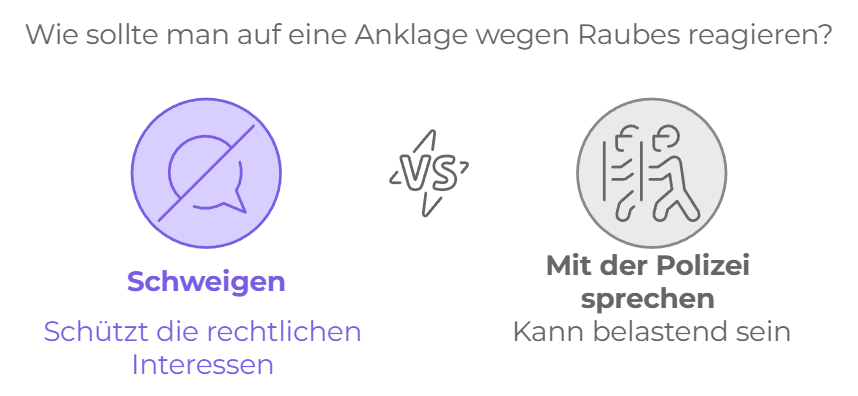
- Exercise Your Right to Remain SilentYou are under no obligation to provide any information to the police. As a general rule, you should strictly exercise this right until you have consulted with a criminal defense attorney.
- Seek Early Legal Counsel Anyone accused of robbery faces a serious felony charge (Verbrechen). The penalties can be severe, making legal representation indispensable. Only an attorney is entitled to full access to the case file and can systematically uncover exculpatory evidence.
- Contact a Court-Appointed or Retained Defense Attorney In the event of an indictment for robbery, you are entitled to a court-appointed defense attorney (Pflichtverteidiger). Nonetheless, you should proactively choose a lawyer specializing in criminal law rather than leaving this decision to the court. This significantly enhances your chances of an effective defense.
- Avoid Costly Mistakes Refrain from discussing the case publicly, such as on social media, or communicating with co-defendants. Investigating authorities could otherwise use your statements against you at a later stage.
When Have You Committed Robbery?
Under Section 249 StGB, robbery occurs when someone takes movable property belonging to another by applying force against a person or issuing a threat of imminent danger to life or limb. In other words, secretly stealing something is not enough. There must also be an element of violence or intimidation through which the perpetrator overcomes the victim’s resistance to take the property.
Simple Examples
- Threat with a knife: A holds a knife to B’s throat and demands: “Give me your wallet or I will hurt you!”, whereupon A takes the wallet. This constitutes robbery because A uses force or the threat of immediate danger to obtain the wallet.
- Punching: A punches B in order to take their smartphone. Here, too, it is evident that physical force is exercised against B so that A can obtain the phone.
What Does Not Count as Robbery?
- Covert theft: If A takes B’s wallet unnoticed from their jacket pocket without using force or threats, this generally constitutes theft rather than robbery.
- A slight accidental shove without criminal intent: Bumping into someone’s shoulder accidentally and taking a bag by mistake does involve taking possession, but lacks the deliberate use of force to compel it. However, a precise assessment of the circumstances is always required.
To be classified as robbery, the combination oftakingandforce/threatsis paramount. The legislature clearly distinguishes this from simple theft, as the use of coercion or intimidation makes the offense considerably more serious.

Differences from Similar Offenses
Robbery (Section 249 StGB) is a serious property crime in which force or threats are used to take an item. In practice, however, overlaps frequently occur with other offenses that appear similar at first glance, particularly regarding their statutory elements. Below is a brief overview:
1. Theft under Section 242 StGB
- Element: Taking movable property belonging to another without force or threats.
- Example: Secretly stealing a handbag from a shopping cart.
- Difference from robbery: A simple taking without coercive means is deemed theft. As soon as the perpetrator uses force or threats, it is classified as robbery.
2. Robbery-Like Theft under Section 252 StGB
- Element: The item is initially stolen unnoticed (theft). Immediately thereafter, the perpetrator uses force or threats to maintain possession of the stolen goods.
- Example: A steals B’s wallet from their pocket. When B pursues them, A threatens B with a stick so that B stops the pursuit, allowing A to escape with the wallet.
- Difference from robbery: The use of force or threats occurs after the actual theft, specifically to retain the stolen property. In a robbery, force is already being applied during the taking.

3. Extortion with Menaces under Section 255 StGB
- Element: A combination of extortion (Section 253 StGB) and robbery-like conduct (force or threats). The victim is actively coerced into handing over property.
- Example: A threatens B with a handgun and says: “Open your safe and give me the money!”.
- Difference from robbery: In robbery, the perpetrator takes the item directly. In extortion with menaces (räuberische Erpressung), the victim is compelled to participate actively (e.g., opening a safe, emptying a bank account, disclosing a PIN).
4. Extortion under Section 253 StGB and Coercion under Section 240 StGB
- Extortion, Section 253 StGB: The victim is induced through threats or force to execute a disposition of property. The threat is often less immediate and not always directed against life or limb.
- Coercion, Section 240 StGB: Aims at compelling an act, acquiescence, or omission. Financial detriment is not strictly required.
- Difference from robbery: Obtaining property is not always the primary objective here. Furthermore, threats in cases of extortion or coercion are often less concretely geared toward immediate physical impact than in robbery.
5. Special Case – Aggravated Robbery under Section 250 StGB
“Simple” robbery becomes aggravated robbery when certain qualifying criteria are met:
- Carrying or using a weapon or dangerous instrument
- Gang-related robbery: At least three individuals are involved in committing the offense
- Severe physical harm or a concrete danger to the victim’s life has occurred
When these circumstances are present, the minimum term of imprisonment increases to three years. If weapons or dangerous instruments are not merely carried, but actively used, a minimum prison sentence of five years applies.

6. Special Case – Robbery Resulting in Death under Section 251 StGB
Here, the robbery results in the killing of a person—whether intentionally or at least through gross negligence (Leichtfertigkeit). Even if there was no direct intent to kill, the consequences can be severe:
- Imprisonment of not less than ten years
- In particularly serious cases, life imprisonment
The legal assessment depends heavily on the specific circumstances, including whether the perpetrator caused the death through gross negligence or indifference.
Key Distinctions
- Robbery vs. Theft: Robbery always involves an element of force or threats. If this is absent, the offense is (generally) theft.
- Aggravated Robbery: Carries higher penalties when additional qualifying circumstances (weapon, dangerous instrument, severe bodily injury) are present.
- Robbery Resulting in Death: A particularly grave offense that can lead to substantially higher sentences, even if the death during the robbery was caused through gross negligence.
- Robbery-Like Theft: The force or threat occurs after the actual theft and serves to secure the stolen property.
- Extortion with Menaces: The victim “provides” the benefit themselves (e.g., by handing it over). Unlike robbery, the perpetrator does not simply take the item, but compels the victim to surrender it.
Why These Distinctions Matter:
The statutory penalties for robbery (Section 249 StGB) and related offenses (e.g., robbery-like theft or extortion with menaces) differ substantially from those for simple theft, extortion, or coercion. Anyone accused of a crime should therefore always ensure that the prosecution’s case is legally classified with precision. An incorrect classification can lead to a significantly higher sentence.
The primary distinction between robbery and related offenses lies in the use of force or threats in direct connection with the taking (robbery), in their chronological sequence (robbery-like theft), or in eliciting an active disposition of property by the victim (extortion with menaces). These differentiations are decisive for sentencing.
Procedural Steps
If you are accused of committing robbery, criminal proceedings typically unfold as follows:
- Preliminary Investigation: Police and prosecutors gather evidence and interrogate witnesses, among other investigative measures.
- Interim Proceedings: The prosecution files an indictment if sufficient suspicion exists. The court then reviews whether to admit the indictment for trial.
- Main Trial: During the court trial, evidence is presented and witnesses are heard. The court subsequently renders its verdict.
- Appeals: Depending on the court instance, an appeal on facts and law (Berufung) or an appeal on points of law (Revision) can be lodged against a conviction.
Particularly during the preliminary investigation, your defense attorney has an effective opportunity to actively shape the course of the proceedings.
Attempted Robbery and Forms of Participation
- Attempted Robbery: Even an attempt is punishable if the perpetrator takes immediate steps toward committing the offense, but it is not completed. The sentencing range may be mitigated, though this varies on a case-by-case basis.
- Forms of Participation: Co-perpetration: Multiple individuals plan and execute the crime jointly—they are (as a rule) treated as principal offenders. Aiding and Abetting: Acts of assistance, without exercising control over the offense, may result in a reduced sentence, particularly if they do not involve the application of physical force against a person.

Juvenile Criminal Law
For defendants between 14 and 18 years of age, juvenile criminal law applies. For defendants between 18 and 21 years of age (young adults/Heranwachsende), juvenile criminal law may be applied. Especially in cases involving serious charges like robbery, the court assesses whether adult criminal law should apply if the accused already demonstrates the requisite maturity. The application of juvenile criminal law offers considerable advantages for the accused:
- Educational focus: Priority of rehabilitation and education over mere punishment.
- Consequences: Instead of lengthy prison terms, educational measures such as community service or social training courses can be prioritized.
Caution Regarding Statements to Police and Media
Following an alleged offense, suspects are often uncertain about how to act. An ill-considered remark, however, can quickly compromise your defense.
Following an alleged offense, suspects are often uncertain about how to act. An ill-considered remark, however, can quickly compromise your defense. 1. Right to Silence
- Police interrogations: A classic example is a police summons. Many accused persons believe they must make a statement immediately to “set the record straight.” Yet in many instances, a premature statement can later be used against you.
- Legal tip: Do not provide any information regarding the facts of the case and contact a defense attorney immediately. Your counsel will evaluate if and when it is advisable to make a statement.
2. Statements in (Social) Media
- Social media profiles: Suspects sometimes post on Facebook, Instagram, or forums to inform friends or followers about their situation. Investigating authorities also monitor these posts—they can be used as circumstantial or direct evidence.
- Example: If someone posts on Instagram, “I only defended myself because the other person provoked me,” this could create the impression that an altercation took place with potential intent.
3. Interviews or Press Inquiries
- Public statements: If journalists approach you or a camera crew arrives at your door, you are under no obligation to speak. It is generally advisable not to attempt public justification before all facts are fully clarified.
- Pitfalls: Inaccurate statements made to the media can later be introduced in court—potentially in a completely different context than you originally intended.
4. Conversations with Third Parties
- Family and friends: Even trusted confidants can inadvertently pass details on to the police or the press.
- Co-defendants: If several individuals are jointly accused of an offense, discussions among them can quickly lead to contradictions that investigators may exploit.
When facing an allegation of robbery, it is strongly advised to avoid all public and uncoordinated statements. Leave communication with the prosecuting authorities entirely to your lawyer. This ensures you do not disclose information that could be misinterpreted or used to your detriment.
Potential Defense Strategies
Your defense in a robbery proceeding depends on the specific circumstances of the case. Typical approaches include:
- Contesting participation in the offense: Eyewitness testimony and other evidence are often susceptible to error.
- Absence of force/threats: In some cases, a statement is overinterpreted as a threat, or a minor scuffle is mischaracterized as an act of physical violence.
- Lack of intent: If criminal intent cannot be established, the charge is significantly weakened.
- Less serious case: If the court determines that a less serious case (minder schwerer Fall) exists, the statutory sentencing range can be reduced substantially.
Psychological Distress and Expert Evaluations
In cases involving mental illness or acute psychological distress, an expert psychiatric evaluation can be decisive in establishing whether and to what extent criminal culpability exists. Substance abuse issues or personality disorders also play a role here. Diminished capacity can, for example, lead to a mitigation of the sentencing range.
Civil Claims
Victims of robbery may assert claims for damages and/or compensation for pain and suffering.
Consequently, you may face civil litigation in addition to criminal proceedings. A victim-offender mediation (Täter-Opfer-Ausgleich) can serve to mitigate the criminal sentence while resolving civil liability.
Immigration Law Consequences
Non-German defendants must be aware of potential consequences for their residency status. A conviction for robbery may result in:
- the revocation of a residence permit
- or an order of deportation.
It is therefore highly advisable to address immigration law concerns as early as possible.
Statistical and Practical Considerations
- Clearance rate: Robbery offenses are often investigated intensively by the police, as there are usually witnesses, surveillance footage, or other tangible evidence.
- Crime prevention: For potential victims, observing general safety precautions (e.g., not carrying cash openly, using well-lit routes) is recommended.
What Penalties Can I Expect?
Below is a tabular overview of the key offenses related to robbery and similar statutory offenses. The table details their respective elements as well as the standard sentencing range.
| Offense | Statute | Elements | Standard Penalty |
| Robbery | Section 249 StGB | – Taking movable property belonging to another using force or threats of imminent danger to life or limb – Intent and intention of unlawful appropriation | Imprisonment of not less than 1 year (in less serious cases: 6 months to 5 years) |
| Aggravated Robbery | Section 250 StGB | – Statutory aggravation of robbery – Aggravating factors: Carrying or using a weapon/dangerous instrument, gang activity, severe physical abuse of the victim, etc. – Severe bodily harm or danger to the victim’s life | Imprisonment of not less than 3 years (under further aggravating circumstances: not less than 5 years) |
| Robbery Resulting in Death | Section 251 StGB | – Death of a person resulting from the robbery – Perpetrator acts at least with gross negligence (no intent to kill required) | Imprisonment of not less than 10 years or life imprisonment |
| Robbery-Like Theft | Section 252 StGB | – Initial theft (taking without force) – Immediately after the act: Use of force or threats to maintain possession of the stolen goods | Imprisonment of not less than 1 year |
| Extortion with Menaces | Section 255 StGB | – Combination of extortion (Section 253) with force or threats – The victim is coerced into a property disposition (e.g., handing over money), not merely passively robbed – Distinction from robbery: In robbery, the perpetrator takes the item; here, the victim must actively surrender it | Imprisonment of not less than 1 year (modeled on Section 249 StGB: often similarly severe penalties) |
| Theft | Section 242 StGB | – Taking movable property belonging to another, generally without force or threats – Perpetrator acts with the intent of unlawful appropriation | Imprisonment of up to 5 years or a fine (depending on severity: potentially increased, e.g., Section 243 StGB) |
| Extortion | Section 253 StGB | – Victim is compelled by threats or force to commit an act (property disposition) – Distinction from extortion with menaces: Force/threats do not necessarily have to be directed as immediately against life or limb as in robbery; the decisive factor is the active cooperation of the victim (handing over property, wire transfer, etc.) | Imprisonment of up to 5 years or a fine (higher in aggravated cases) |
| Coercion | Section 240 StGB | – Use of force or threat of a perceptible evil to compel an act, acquiescence, or omission – Does not necessarily involve the taking or transfer of property; the focus is on overriding free will (e.g., forcing a specific action) | Imprisonment of up to 3 years or a fine (higher in particularly serious cases) |
Robbery Offenses / Robbery-Related Offenses and Their Penalties
In each individual case, the specific circumstances dictate the penalty—in particular the means used, the severity of any resulting injuries, and any prior convictions.
Do I Need a Lawyer?
Yes. Robbery constitutes a felony (Verbrechen), meaning that a substantial prison term is at stake. Consequently, this represents a mandatory defense case (notwendige Verteidigung). You are entitled to a court-appointed defense attorney, but you may choose a certified specialist in criminal law (Fachanwalt für Strafrecht) yourself rather than leaving this decision to the court.
Benefits of early legal counsel:
- Strategic planning as early as the preliminary investigation
- Reviewing and formally petitioning for exculpatory evidence
- Tactical guidance regarding statements and courtroom strategy during the main trial
Conclusion
An allegation of robbery (Section 249 StGB) must be taken with the utmost seriousness, as even simple robbery is punishable by a minimum of one year of imprisonment. Aggravated forms (Sections 250, 251 StGB) can significantly increase the sentence. The outcome of the proceedings hinges on many factors: factual details of the offense, personal circumstances (e.g., juvenile criminal law, psychological aspects), and the quality of your defense. We specialize in criminal defense for robbery and theft proceedings. Backed by years of experience in criminal law, we advise and represent clients nationwide throughout Germany. If you have questions or have received a summons, please contact us as early as possible so we can safeguard your rights effectively.
FAQ: Robbery
What exactly constitutes robbery under the law, and how does it differ from theft?
Robbery (Section 249 StGB) occurs when someone takes movable property belonging to another by applying force or threatening imminent danger to life or limb. The critical distinction from theft is the use of force or threats. Secretly taking property without force is merely theft. Robbery carries a mandatory minimum penalty of one year of imprisonment, whereas theft is punishable by a fine or up to five years of imprisonment.
What should I do if I am accused of robbery?
If you face an allegation of robbery, you should first remain calm and exercise your right to remain silent. Refrain from making spontaneous statements to the police and consult a criminal defense attorney without delay. Because robbery is a felony, you are entitled to a court-appointed attorney, but you should actively retain a certified specialist if possible. Above all, strictly avoid posting on social media, speaking to the press, or conferring with co-defendants.
What penalties apply upon a conviction for robbery?
The penalty for “simple” robbery under Section 249 StGB is at least one year of imprisonment, or six months to five years in less serious cases. For aggravated robbery (Section 250 StGB), such as offenses involving weapons or committed as part of a gang, the minimum penalty increases to three years, and to five years under certain statutory aggravations. Robbery resulting in death (Section 251 StGB) carries a prison sentence of not less than ten years or life imprisonment. Ancillary consequences, such as civil damage claims by victims or immigration consequences for non-German citizens, may also arise.
What defense strategies are available against a robbery charge?
Depending on the specific circumstances, several defense approaches may be pursued: contesting participation in the offense where eyewitness evidence is flawed; establishing the absence of force or threats where an incident was overinterpreted; arguing a lack of criminal intent; or presenting factors that justify a less serious case. In cases of mental health issues or acute crises, an expert evaluation can address criminal culpability. In juvenile matters, the educational aspect remains paramount.
How does extortion with menaces differ from robbery?
In extortion with menaces (Section 255 StGB), the victim is actively compelled by force or threats to make a disposition of property, such as opening a safe or surrendering money. The distinction from robbery is that in robbery, the perpetrator takes the property directly, whereas in extortion with menaces, the victim is coerced into handing it over. Both offenses carry a mandatory minimum sentence of one year of imprisonment and are penalized with comparable severity.
Consultation via Video Conference
Our attorneys provide personal consultations regardless of your location – via secure video conferencing, throughout Germany.
Schedule an Appointment
Ihr Kontakt zu uns
Schildern Sie uns Ihren Fall vertraulich
Schildern Sie kurz, was passiert ist und ob Fristen oder Termine laufen. Wir melden uns in der Regel innerhalb von 24 Stunden, um das weitere Vorgehen und die benötigten Unterlagen zu klären.
Call directly