

October 13, 2024
|
in Criminal Law
in Tax Law
by Dr. Anthea Pitschel
Key Facts About Asset Seizure Orders at a Glance
- Goal and Purpose: The asset seizure order serves to secure enforcement by safeguarding assets (movable and immovable property) and often has a deterrent effect in cases of tax crimes and money laundering.
- Requirements for the Order: The order is usually issued by the court; in urgent cases, the public prosecutor’s office may also take action. Initial suspicion and a need for security must be present.
- Legal Remedies for Those Affected: Various legal remedies are available against the order, such as a simple appeal against court decisions or an application for judicial review if ordered by the public prosecutor’s office.
- Possible Double Burden: In tax criminal proceedings, an asset seizure can be ordered in parallel by tax authorities pursuant to § 324 AO, which represents an additional burden for those affected.
Criminal Law – What does asset seizure mean in criminal proceedings?
An asset seizure order in tax criminal proceedings enables the confiscation of equivalent value from the affected party through the attachment of movable and immovable property. This measure has two main purposes:
- It is intended to deter potential tax offenders and perpetrators of money laundering
- It serves to secure the enforcement of claims by the injured party (usually the state)
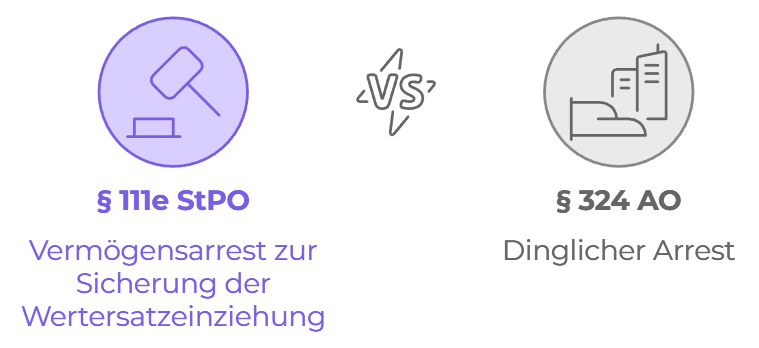
There are two different types of asset seizure:
- Asset seizure pursuant to § 111e StPO (Code of Criminal Procedure)
- In rem attachment pursuant to § 324 AO (Fiscal Code)
Attachment: Recording of assets
Criminal asset seizure pursuant to § 111e StPO (Code of Criminal Procedure)
Although asset seizure under the Code of Criminal Procedure is less well-known to the public than pre-trial detention, it is one of the most serious coercive measures in criminal proceedings. The requirements for its order are surprisingly low compared to the drastic consequences for those affected.
Formal Requirements: Who may order an asset seizure?
As a rule, the asset seizure must be ordered by the competent court. Only in exceptional cases, when there is imminent danger, may the public prosecutor’s office also order this measure (§ 111j StPO).
Jurisdiction of the courts in detail:
- During the investigative proceedings: The investigative judge at the local court in whose district the public prosecutor’s office is located
- After indictment: The court handling the case
- In appeals proceedings: The appellate court after receipt of the files
- In revision proceedings: The court whose judgment is being contested
The judicial decision is made by way of a written, reasoned order.
Order by the public prosecutor’s office in case of imminent danger
In case of imminent danger (§ 111j para. 1 sentence 2 StPO), the public prosecutor’s office may also order the asset seizure. In this case, however, it must obtain confirmation from the competent court within one week.
Substantive Requirements: When is an asset seizure lawful?
Four essential conditions must be met for the ordering of an asset seizure:
- Initial suspicion
- Eligible seizure claim
- Need for security
- Proportionality while observing time limits
Initial suspicion as a basic requirement
For initial suspicion under § 152 para. 2 StPO, it must appear at least possible, based on criminalistic experience, that a prosecutable offense has been committed. The asset seizure can therefore be ordered at the very beginning of an investigative proceeding.
What is an eligible seizure claim?
The eligible seizure claim substantiates the initial suspicion for the asset seizure. There must be sufficient indications that the accused will be obligated to pay equivalent value upon conclusion of the proceedings.
The need for security as an important requirement for asset seizure
The need for security is an essential limitation on asset seizure and protects the fundamental right to property under Art. 14 para. 1 GG (Basic Law). It requires that the asset seizure:
- is necessary and
- required
In addition, objective circumstances must exist that suggest, in the individual case, that the asset seizure is required to secure later enforcement. Such circumstances may include, for example:
- The accused refuses to disclose their financial circumstances
- There are signs of concealment of actual assets
The importance of proportionality
The principle of proportionality permeates the entire ordering of the asset seizure. The public interest in security must be weighed against the affected party’s constitutionally protected right to property (Art. 14 GG).

Time limits for asset seizure
The time component of the asset seizure is particularly important. Although proportionality can be seriously questioned after about six months, it must be assessed specifically in each individual case.
Defending against an asset seizure: What legal remedies do those affected have?
Those affected by an asset seizure are not defenseless. Depending on which authority ordered the asset seizure, various legal remedies are available:
Legal remedies against court orders
In the case of an order by the court, the affected party has the simple appeal under § 304 StPO at their disposal:
- Initially before the local court
- In the event of a negative decision, the regional court decides as the appellate court
- Further action is only possible if the seizure exceeds 20,000 euros (§ 310 para. 1 no. 3 StPO)
In the case of longer proceedings, an application for the lifting of the asset seizure is also recommended.
Legal remedies against orders by the public prosecutor’s office
An application for a judicial decision can be filed against an order by the public prosecutor’s office:
- If the court confirms the lawfulness, a simple appeal under § 304 para. 1 no. 3 StPO is possible
- If applicable, a further appeal under § 310 para. 1 no. 3 StPO is also admissible
In rem attachment by tax authorities pursuant to § 324 AO
Parallel ordering option by tax authorities
A special situation exists in tax criminal proceedings: In addition to the asset seizure, the tax authorities can take parallel action against the tax debtor under § 324 AO. This can lead to the attachment of both movable and immovable property and significantly increases the intensity of the intervention. This double burden often occurs, particularly in cases of tax evasion and money laundering.
Earlier intervention possibility for tax authorities
The early point in time at which tax authorities can take action is problematic:
- It is sufficient if the claim from the tax debt relationship has arisen according to § 38 AO
- However, the tax authority is subject to fixed deadlines in this procedure
Legal protection options against in rem attachment
Several legal remedies are available to the affected party against an in rem attachment under § 324 AO:
- Recourse to the tax courts under § 33 para. 1 no. 2 FGO
- An application for an interim order
- An application for a stay of execution
Why you need legal assistance in the event of an asset seizure
The problem of the double burden
Since affected parties are often confronted with both an asset seizure and an in rem attachment under § 324 AO at the same time, a significant double burden arises. This makes professional legal advice particularly important.
The importance of expert advice
A specialized attorney can:
- Select the most sensible legal remedy in terms of content and timing
- Ideally, obtain a quick lifting of the seizure order
For an optimal defense against an asset seizure order, contacting a specialist lawyer for criminal law and tax criminal law is indispensable.
Understanding asset seizure as a serious measure and acting correctly
Asset seizure to secure enforcement represents a significant intervention in the financial affairs of the affected party. The attachment of movable and especially immovable property can be life-threatening. Due to the comparatively low hurdles for ordering the confiscation of equivalent value and the possible double burden of criminal and tax law measures, early and competent legal advice is crucial.
If you have questions about asset seizure or if you are affected yourself, the specialist lawyers at Mügge, Dr. Pitschel & Partner are happy to assist you with their expertise in tax criminal law.
Consultation via Video Conference
Our attorneys provide personal consultations regardless of your location – via secure video conferencing, throughout Germany.
Schedule an Appointment
Ihr Kontakt zu uns
Schildern Sie uns Ihren Fall vertraulich
Schildern Sie kurz, was passiert ist und ob Fristen oder Termine laufen. Wir melden uns in der Regel innerhalb von 24 Stunden, um das weitere Vorgehen und die benötigten Unterlagen zu klären.
Call directly