

September 24, 2023
|
in Criminal Law
by Dr. Anthea Pitschel
Murder by Treachery – A Brief Overview
- Distinction between Murder and Manslaughter: Contrary to popular belief, it is not the planning but the presence of a specific murder criterion that is decisive.
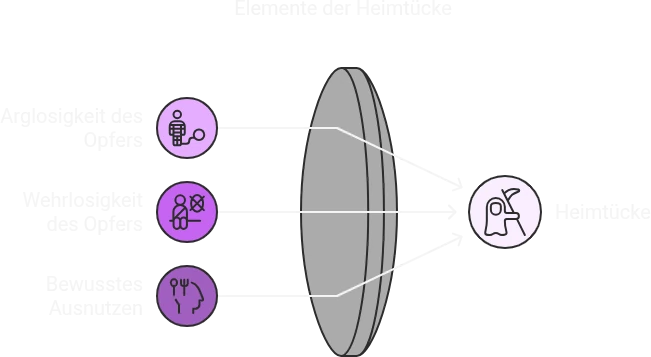
- Definition of Treachery (Heimtücke): A person kills treacherously if they deliberately exploit the victim’s unsuspecting and defenseless state with a hostile intent.
- Unsuspecting State (Arglosigkeit): The victim does not anticipate an attack; this state must exist at the relevant time of the offense.
- Defenselessness (Wehrlosigkeit): The victim’s ability to defend themselves is significantly restricted due to their unsuspecting state.
- Current Federal Court of Justice (BGH) Case Law: The lethal attack does not begin only with the actual act of killing but also encompasses the phase immediately preceding it.
- Criminal Consequences: Treacherous murder is punished with life imprisonment, whereas manslaughter is punished with a prison sentence of 5 to 15 years.
Criminal Law: The Fundamental Difference Between Murder and Manslaughter
A widespread misconception among the public is the assumption that the difference between murder and manslaughter lies in the planning of the act. Many people falsely believe that a killing is only to be classified as murder if it was planned, whereas manslaughter occurs in the heat of the moment. However, this popular notion does not correspond to the legal reality in Germany.
In truth, both offenses – both murder and manslaughter – must be committed with basic intent. The decisive difference lies in the presence of special characteristics defined in the Criminal Code as “murder criteria” (Mordmerkmale). One of the most frequent and particularly relevant murder criteria in case law is treachery (Heimtücke).
The Murder Criteria According to Section 211 StGB
Legal Basis and Structure
In German criminal law, murder is regulated in Section 211 StGB. According to Section 211 (1) StGB, a murderer is punished with life imprisonment. Section 211 (2) StGB defines the murder criteria:
“A murderer is anyone who kills a person out of the lust to kill, to satisfy sexual desires, out of greed or other base motives, treacherously or cruelly or by means involving common danger or in order to facilitate or cover up another crime.”
The murder criteria can be divided into three groups:
- Motives for the act (lust to kill, satisfaction of sexual desire, greed, base motives)
- Execution of the act (treacherous, cruel, means involving common danger)
- Purpose of the act (facilitating or covering up another crime)
Treachery as a Particularly Relevant Murder Criterion
Of all the murder criteria, treachery is particularly relevant in practice and is examined by the courts in many cases. This is because this characteristic often plays a decisive role in the borderline between murder and manslaughter, and its determination is often associated with particular difficulties.
Definition and Requirements of Treachery
Legal Definition
What exactly is the murder criterion of treachery? According to the established case law of the Federal Court of Justice, a person acts treacherously if they deliberately exploit the unsuspecting and defenseless state of the victim with a hostile intent.
The Three Core Elements of Treachery
1. Unsuspecting State of the Victim (Arglosigkeit)
A person is unsuspecting if they do not anticipate an attack at the time of the act. The victim therefore does not expect to be attacked and is consequently unprepared. Being unsuspecting is a subjective element based on the victim’s perception and assessment.
On the other hand, a person who expects or even anticipates an attack is not unsuspecting. This may be the case, for example, if the attack was preceded by an argument in which physical violence had already been threatened.
2. Defenselessness of the Victim (Wehrlosigkeit)
The victim is defenseless if, as a result of being unsuspecting, their defensive capabilities are so restricted that they cannot ward off or impede the attack. The defenselessness must be causally based on the unsuspecting state – the victim is therefore unable to defend themselves precisely because they do not expect an attack.
Even people who are generally defenseless due to physical limitations or their situation (e.g., while sleeping) can be killed treacherously if they are simultaneously unsuspecting.
3. Deliberate Exploitation with Hostile Intent
The perpetrator must recognize the victim’s unsuspecting and defenseless state and deliberately take advantage of it. It is not enough for the victim to be accidentally unsuspecting – the perpetrator must perceive this and exploit it specifically. Furthermore, this must happen with a “hostile intent,” which means the perpetrator exploits the situation to the victim’s detriment.
Challenges in Determining Treachery
Timing of the Unsuspecting State
One of the central difficulties in determining treachery is establishing the relevant point in time for assessing the unsuspecting state. The BGH has clarified in its case law that the start of the lethal attack is what matters. However, this point in time can be difficult to determine, especially in multi-stage sequences of events.
Start of the Lethal Attack
In a landmark ruling, the BGH (Judgment of May 24, 2023, Case No. 2 StR 320/22) specified that the attack “does not begin only with the actual act of killing, but also encompasses the phase immediately preceding it.” This means that preparatory acts that lead directly into the act of killing can also be part of the attack.
Continuing Effect of Circumstances Establishing Treachery
The BGH has also established that treacherous conduct can also lie in precautions taken by the perpetrator to create a favorable opportunity for the killing, provided these still have an effect during the act. This significantly expands the scope of application for treachery.
The Current BGH Case on Treachery (2023)
Facts of the Case
In 2022, the Cologne Regional Court sentenced a man for manslaughter to the detriment of his extramarital partner (LG Köln, Judgment of March 17, 2022, Case No. 104 Ks 23/21).
In 2020, the defendant had driven with the woman in her car to a secluded location. While the woman was sitting in the passenger seat of the stationary vehicle, the defendant shot her twice in the head from very close range. The defendant was either outside the vehicle on the passenger side or behind the passenger seat on the back bench.
Assessment by the Cologne Regional Court
The Cologne Regional Court denied the presence of treachery because it could not be established with certainty that the woman was actually unsuspecting at the moment the first shot was fired. The court considered it possible that the defendant had previously threatened her with the firearm, which would have eliminated the unsuspecting state.
Decision of the BGH
The BGH overturned the judgment of the Cologne Regional Court and referred the case back for a new trial. In the view of the BGH, the Regional Court had applied too narrow a standard:
- The Regional Court had incorrectly focused only on the moment of the first shot for the timing of the attack.
- The BGH emphasized that the attack does not begin only with the actual act of killing but also encompasses the phase immediately preceding it.
- Even if a prior threat had taken place, this would not automatically rule out treachery.
- The Regional Court should have examined whether the woman had any chance of flight or defense at all during a possible threat.
Legal Consequences of the BGH Decision
The BGH decision shows that the examination of treachery must be nuanced:
- Even if the perpetrator initially threatens the victim and thus removes their unsuspecting state, treachery can exist if the victim nevertheless remains defenseless.
- The perpetrator can deliberately bring about the victim’s unsuspecting and defenseless state by first placing them in a situation where they can no longer defend themselves.
- The decisive factor is not only the moment of the act of killing itself, but the entire complex of actions leading directly to the killing.
Other Significant Case Law on Treachery
Classic Scenarios of Treacherous Killing
Killing While Asleep or from Ambush
Classic examples of treacherous killings are attacks on sleeping victims or attacks from ambush. In these cases, the unsuspecting state is regularly present, as the victim does not anticipate any attack.
Killing After Feigning Peaceful Intentions
Treachery also exists if the perpetrator initially feigns peaceful intentions and then attacks unexpectedly. The BGH has emphasized in several decisions that the exploitation of a relationship of trust in particular can be a typical characteristic of treachery.
A particularly spectacular case in which the feigning of peaceful intentions played a central role is the so-called “Doppelgänger Murder” of Eppingen, in which the victim was lured into a trap under the pretext of a free cosmetic treatment.
Limits of Treachery
Open Hostility and Prior Threats
There is no unsuspecting state, and thus no treachery, if there is open hostility between the perpetrator and the victim and the victim must expect an attack. Prior specific threats can also exclude the unsuspecting state.
Special Groups of Victims
The BGH has dealt in several decisions with the question of whether certain victim groups, such as small children or unconscious persons, can be unsuspecting at all. In the case of small children, the BGH denied the unsuspecting state because they cannot yet recognize the danger. In the case of unconscious persons, the unsuspecting state was also denied because they cannot perceive an attack.

Practical Significance of the Distinction Between Murder and Manslaughter
Criminal Consequences
The distinction between murder and manslaughter has significant implications for the sentence:
- Murder (Section 211 StGB): Life imprisonment
- Manslaughter (Section 212 StGB): Imprisonment for 5 to 15 years
In cases of particular severity of manslaughter, a life sentence can also be imposed pursuant to Section 212 (2) StGB, but this is the exception.
Significance for the Defense
For the defense in homicide cases, the question of whether treachery is present is often decisive. The defense strategy will focus on refuting the presence of treachery, in particular by:
- Proving that the victim was not unsuspecting (e.g., due to prior disputes or threats)
- Demonstrating that the perpetrator did not deliberately exploit the unsuspecting and defenseless state
- Arguing that the act was committed in the heat of the moment and the perpetrator did not coolly calculate the situation
In a successful defense case before the Göttingen Regional Court, our firm was able to achieve, through a targeted defense strategy, that a defendant originally charged with manslaughter was only convicted of obstruction of justice.
Procedural Particularities
In proceedings for murder, the Jury Court (Schwurgericht) is always responsible, whereas in the case of manslaughter, the Large Criminal Chamber can also decide. Furthermore, the requirements for the presentation of evidence for murder criteria are particularly high, as these must be established beyond a reasonable doubt.
Frequently Asked Questions About Murder by Treachery
Why is treachery considered
Treachery is considered particularly reprehensible in case law because the perpetrator attacks the defenseless victim in a situation where they cannot defend themselves. The deliberate exploitation of the unsuspecting and defenseless state shows a particular dangerousness and moral reprehensibility, as the perpetrator deprives the victim of any chance of self-protection. This particular reprehensibility of the behavior is a major reason why the legislator defined treachery as a murder criterion that justifies the imposition of a life sentence.
What is meant by the
The “legal consequences solution” (Rechtsfolgenlösung) is an approach developed by the Federal Constitutional Court to be able to deviate from the mandatory life sentence in certain cases despite the presence of murder criteria. This can be the case in extraordinary circumstances where a life sentence appears disproportionate. The legal consequences solution allows courts to impose a fixed-term prison sentence in such cases instead of life imprisonment, without the statutory definition of murder being called into question.
How does the
“Negative type correction” (negative Typenkorrektur) is an approach in case law where, despite the objective presence of all characteristics of treachery, a classification as murder can be denied if the perpetrator’s behavior in the specific situation does not correspond to the typical image of a treacherous murderer. This can be the case, for example, in acts committed out of despair or in emotionally highly charged situations. The BGH applies negative type correction cautiously but recognizes that not every treacherous killing must automatically exhibit the full moral reprehensibility of murder.
What role does the perpetrator’s intent play in the assessment of treachery?
In a treacherous killing, the perpetrator’s intent must extend to both the act of killing and the circumstances of the treachery. The perpetrator must therefore not only know and want to kill the victim but also recognize and exploit the fact that the victim is unsuspecting and defenseless. Conditional intent (dolus eventualis) is sufficient – the perpetrator must recognize the possibility of the killing and the victim’s unsuspecting and defenseless state and accept it. However, case law places high demands on the proof of this double intent, which in practice can often lead to significant evidentiary difficulties.
What distinguishes act-related murder criteria like treachery from perpetrator-related murder criteria?
Act-related murder criteria such as treachery or killing by means involving common danger refer to the manner in which the act was carried out, while perpetrator-related murder criteria such as the lust to kill or base motives concern the motivation and attitude of the perpetrator. In the case of act-related murder criteria, the external appearance of the act is evaluated, while in the case of perpetrator-related murder criteria, the internal attitude of the perpetrator is decisive. In practice, this means that act-related murder criteria are often easier to prove because they are based on objective circumstances, whereas perpetrator-related murder criteria require a more comprehensive taking of evidence regarding the internal side of the act.
Conclusion and Outlook
The distinction between murder by treachery and manslaughter remains one of the most demanding tasks in criminal law practice. Current BGH case law shows that the examination must be nuanced and the entire complex of actions must be taken into account.
Case law on treachery is constantly evolving and reacting to new scenarios. It remains to be seen how the Cologne Regional Court will decide in the referred case and what further specifications the BGH will make in the future.
For practice, this means that a careful analysis of the specific circumstances of the act is essential in order to be able to make a correct legal classification.
Consultation via Video Conference
Our attorneys provide personal consultations regardless of your location – via secure video conferencing, throughout Germany.
Schedule an Appointment
Ihr Kontakt zu uns
Schildern Sie uns Ihren Fall vertraulich
Schildern Sie kurz, was passiert ist und ob Fristen oder Termine laufen. Wir melden uns in der Regel innerhalb von 24 Stunden, um das weitere Vorgehen und die benötigten Unterlagen zu klären.
Call directly