

March 23, 2025
|
in Criminal Law
by Dr. Anthea Pitschel
Penalties for Delaying Insolvency Filing – Brief Overview
- Delaying an insolvency filing (Insolvenzverschleppung) is not an oversight—it is an independent criminal offense under white-collar criminal law. Any managing director of a GmbH, AG, or UG who fails to file for insolvency in a timely manner despite the company being insolvent faces criminal liability.
- Insolvency (Insolvenzreife) exists in the event of: Illiquidity / Inability to pay (Section 17 InsO): the company can no longer settle due debts Overindebtedness (Section 19 InsO): assets no longer cover liabilities and there is no positive going-concern forecast (Fortführungsprognose) Imminent illiquidity (Section 18 InsO): it is foreseeable that the company will soon be unable to make payments As soon as one of these grounds exists, the duty to file for insolvency begins. The deadlines: 3 weeks in the event of illiquidity or imminent illiquidity 6 weeks in the event of overindebtedness
- Please note: The deadline does not begin only when the managing director “notices” it, but when they should have recognized it upon due examination (Section 15a (1) InsO).
- Sentencing range: Up to 3 years of imprisonment or a fine if committed intentionally; up to 1 year of imprisonment or a fine if committed negligently.
- Statute of limitations: 5 years for intentional, 3 years for negligent delayed insolvency filing.
Legal Framework and Criminal Liability
Criminal liability for delaying an insolvency filing is primarily governed by Section 15a (4) and (5) InsO. In addition, white-collar criminal provisions may apply:
Section 15a InsO – The Primary Provision
It penalizes both intentional and negligent failure to file in a timely manner—for:
- Managing directors of a GmbH / UG
- Management board members of an AG
- Managing directors of a GmbH & Co. KG
- Liquidators
- Authorized representatives of cooperatives or registered associations
Other Relevant Provisions
- Section 283 StGB (Bankruptcy / Bankrott)When, for example, assets are shifted, bookkeeping obligations are breached, or creditors are deceived during a crisis.
- Section 266a StGB (Withholding of Social Security Contributions)A classic accompanying offense, particularly when payroll continues despite a lack of funds.
- Section 263 StGB (Fraud)When new liabilities are incurred despite illiquidity—frequently relevant for sole proprietors.
Partnerships & Sole Proprietorships
These are not obligated to file under Section 15a InsO, but may be prosecuted, for example, for criminal bankruptcy or fraud.
Important: Since the 2023 InsO reform, registered associations (Vereine) are also subject to a duty to file for insolvency—with corresponding criminal liability in the event of a breach of duty.
Do you need legal support regarding suspected delayed insolvency filing?
Our certified specialists in criminal law & tax law offer a confidential initial consultation at a fixed rate of €280 plus VAT and will work with you to develop a strategic course of action.
Penalties for Delaying Insolvency Filing
Statutory Sentencing Range
| Delaying Insolvency Filing | Sentencing Range |
| Intentional | Imprisonment for up to 3 years or a fine |
| Negligent | Imprisonment for up to 3 years or a fine |
Additionally, the following consequences may arise:
- Professional disqualification (Section 6 GmbHG) → e.g., disqualification from acting as managing director for up to 5 years
- Entry in the criminal record / certificate of conduct (starting at 91 daily fine units or 3 months of imprisonment)
Typical Sentencing in Practice
| Delaying Insolvency Filing | First-time offenders | Under aggravating circumstances |
| Intentional | 90–180 daily fine units | Imprisonment for 6–24 months, potentially suspended on probation |
| Negligent | 30–90 daily fine units | 90–180 daily fine units |
| + Bankruptcy offense | Imprisonment for 6–18 months on probation | Imprisonment for 1–3 years, potentially without probation |
Aggravating factors include in particular:
- Long duration of the delay (several months)
- Substantial financial damages caused to creditors
- Relevant prior convictions
- Systematic conduct
- A high number of affected employees
Case law example: In 2023, a managing director was sentenced to 2 years of imprisonment on probation after delaying the insolvency filing by more than 8 months and accepting customer payments totaling €300,000 during that period, even though the services could no longer be rendered.
Criminal Prosecution in Practice
How Do Investigative Proceedings Arise?
An investigation into delayed insolvency filing is often initiated by the following triggers:
- Report by the insolvency administrator: The administrator routinely examines whether an insolvency petition was filed on time. If there is a suspicion of delayed filing, they are legally required to report it.
- Report by creditors: Major creditors or suppliers facing significant payment defaults frequently set criminal prosecution in motion.
- Report by social security agencies: If social security contributions are not remitted, a criminal complaint is usually filed automatically.
- Report by employees: Particularly from accounting or finance departments—often providing detailed information on the company’s financial standing.
- Routine review following an insolvency filing:The public prosecutor’s office routinely examines every corporate insolvency to determine whether there are indications of a delayed filing.
Typical Course of Criminal Proceedings
- Preliminary Proceedings
- Search of commercial and residential premises
- Seizure of documents and data
- Interrogation of managing directors, tax advisors, and employees
- Preparation of an expert opinion on the date of insolvency (Insolvenzreife)
- Indictment or Penalty Order
- Indictment in the event of sufficient suspicion → Main trial
- Or penalty order (Strafbefehl) → Written proceedings without a court trial
- Main Trial and Judgment
- Proceedings usually before the Local Court (Amtsgericht)
- In serious cases before the White-Collar Crime Division of the Regional Court (Landgericht)
- Judgment: Fine, imprisonment (potentially on probation), professional disqualification
Statute of Limitations for the Offense
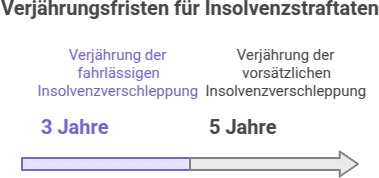
Criminal prosecution is subject to the following limitation periods:
- Intentional delayed insolvency filing: 5 years
- Negligent delayed insolvency filing: 3 years
Limitation Period
Criminal prosecution is subject to the following limitation periods:
The limitation period begins upon the cessation of business operations or upon the opening of insolvency proceedings.
Practical note: Investigations are often only concluded years after the insolvency. However, prosecuting authorities have effective means of tolling or interrupting the statute of limitations, such as interrogations or other investigative actions.
Defense Options in Criminal Proceedings
When facing an allegation of delayed insolvency filing, several defense approaches are available:
1. Documentation of Solvency
→ Proof that at the relevant time, no legal state of insolvency existed:
- Liquidity calculations
- Incoming payments
- Credit agreements
- Deferrals or installment payment plans
2. Evidencing Restructuring Efforts
→ Restructuring attempts within the statutory deadline can have an exonerating effect:
- Proof of discussions with banks, investors; commissioned restructuring opinions
- Operational restructuring measures
3. Seeking Professional Advice
→ Relying on qualified advice can, in exceptional cases, establish an unavoidable mistake of law (Verbotsirrtum):
- Tax advisor certification regarding solvency
- Legal assessment regarding the duty to file for insolvency
- Auditor forecasts
4. Lack of Fault in Cases of Negligence
→ Proof that all reasonable measures were taken:
- Internal control systems
- Regular liquidity reviews
- Early warning systems
Case example: In a matter handled by our law firm, an acquittal was achieved for a GmbH managing director by demonstrating that he was entitled to rely on the statements of his tax advisor regarding ongoing solvency and had conducted independent, regular liquidity reviews. The public prosecutor’s office had determined the onset of insolvency incorrectly.
Case Studies from Our Firm’s Practice
Case 1: Dismissal of Proceedings Upon Payment of a Monetary Condition
Facts: The managing director of a mid-sized construction GmbH faced substantial liquidity difficulties following the default of a major client. Despite clear indications of illiquidity, he continued operations for another three months before filing for insolvency.
Defense strategy: We were able to prove that the client had undertaken intensive restructuring efforts, including:
- Documented negotiations with an equity investment firm
- Multiple discussions with the primary bank regarding an extension of the credit line
- A commissioned restructuring opinion that was finalized only shortly before the insolvency petition was filed
Outcome: Although objective delayed insolvency filing was present, dismissal of the proceedings under Section 153a StPO was achieved upon payment of a €15,000 monetary condition. A criminal conviction was thereby avoided.
Case 2: Acquittal Due to Lack of Intent
Facts: The management board member of a mid-sized mechanical engineering enterprise (AG) was accused of delaying the insolvency filing by four months. The prosecution based its case on an expert opinion that established illiquidity as early as that prior date.
Defense strategy: We were able to demonstrate that:
- The client regularly and comprehensively reviewed the liquidity situation with the tax advisor and auditor
- A positive going-concern forecast from the auditor was present
- Concrete orders were in the pipeline that were only delayed due to unforeseeable circumstances
- The client had taken all reasonable measures to monitor the financial situation
Outcome: The court acquitted the client, as neither intent nor negligence could be proven. The assessment of insolvency was recognized as a complex predictive decision in which the board member is afforded a certain degree of discretion.
Case 3: Suspended Sentence in a Severe Case of Delayed Insolvency Filing
Facts: Despite obvious illiquidity, the managing director of an IT service provider continued operations for more than eight months. During this period, substantial liabilities were incurred and customer advance payments were accepted.
Defense strategy: In light of the overwhelming evidence, we focused on mitigating the sentence through:
- A full confession and demonstration of remorse
- Evidence of personal efforts by the client to compensate creditors out of personal assets
- An absence of prior criminal convictions
- Personal circumstances (family maintenance obligations, health issues)
Outcome: The client was sentenced to imprisonment for one year and six months, which was suspended on probation. In addition, a monetary condition of €10,000 had to be paid to charitable organizations.
Frequently Asked Questions About Criminal Consequences
Is the public prosecutor obligated to investigate?
Yes. Principle of legality (Legalitätsprinzip): If an initial suspicion exists, an investigation must be initiated. In practice, however, enforcement is selective—such as following a report by an insolvency administrator or in major loss cases.
Is a minor deadline overrun sufficient for criminal penalties?
In principle, yes—even a delay of a few days can be punishable. What matters is immediacy and whether the legal state of insolvency has actually occurred.
Is a managing director liable despite consulting a tax advisor?
Yes. Responsibility for filing for insolvency cannot be delegated. However, proper documentation from a tax advisor can serve to exonerate you.
Does D&O insurance cover delayed insolvency filing?
As a rule, no. Many policies explicitly exclude intentional acts or criminal offenses. In some instances, however, defense costs are covered.
What can I do to protect myself?
- Establish an early warning system
- Regularly maintain a liquidity plan
- Seek external advice early on
- Document restructuring options
- Take responsibilities as a managing director seriously
Is a tax advisor criminally liable if they fail to recognize insolvency?
Tax advisors generally have no independent duty to alert their clients to insolvency unless they have been explicitly engaged to conduct such an assessment. However, if there are obvious indications of insolvency, a duty to advise may arise under general advisory obligations. Criminal liability for aiding and abetting delayed insolvency filing only applies in cases of active involvement (e.g., preparing misleading documentation).
Conclusion – Avoiding Delayed Insolvency Filings
The criminal consequences of delaying an insolvency filing can be severe, ranging from fines to multiple years of imprisonment. Seeking legal counsel at an early stage—ideally at the first signs of a corporate crisis—is the most effective protection against criminal risks.
Take Action Now
As a specialized law firm in insolvency criminal law and white-collar criminal defense, we provide preventive counsel to help you avoid criminal liability and represent you competently if investigative proceedings have already been initiated.
Consultation via Video Conference
Our attorneys provide personal consultations regardless of your location – via secure video conferencing, throughout Germany.
Schedule an Appointment
Ihr Kontakt zu uns
Schildern Sie uns Ihren Fall vertraulich
Schildern Sie kurz, was passiert ist und ob Fristen oder Termine laufen. Wir melden uns in der Regel innerhalb von 24 Stunden, um das weitere Vorgehen und die benötigten Unterlagen zu klären.
Call directly