

May 26, 2024
|
in Criminal Law
in Insights & Articles
by Dr. Anthea Pitschel
Penalty Order – Overview and Defense Options – Brief Summary
- Penalty without a trial: A penalty order imposes a penalty for an offense without a court trial in order to expedite proceedings and reduce costs.
- Two-week deadline for objection: If you receive a penalty order, you have only two weeks to file an objection. Do not hesitate to act quickly.
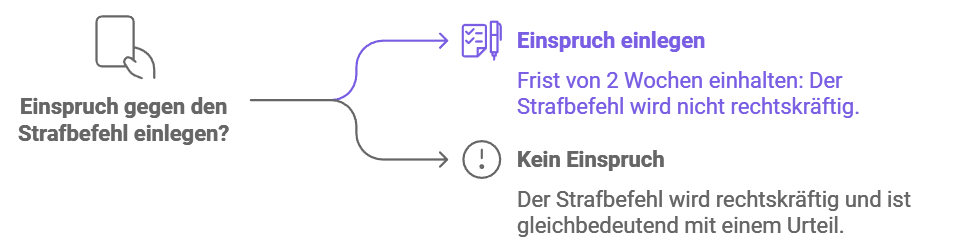
- Options upon receipt: You may accept the penalty order and the penalty, or file an objection within the deadline.
- Consequences of acceptance: Accepting the penalty order may result in an entry in the Federal Central Criminal Register, which can have professional and personal ramifications.
- Objection and defense: An objection sets aside the penalty order and generally leads to a main hearing where you can present your defense and submit evidence.
- You open your mailbox and find a yellow envelope containing a document that imposes a penalty on you. If you have received such a penalty order, you should act immediately and seek legal counsel. Because an objection to a penalty order must be lodged within two weeks of service via formal notice of delivery, you should take swift action and consult a legal professional.
What is a penalty order?
A penalty order is a written court order that imposes a penalty for a specific unlawful act without a prior oral hearing having taken place. It is frequently referred to as a “judgment without a main hearing” and is primarily utilized for less serious misdemeanor offenses. If you find such a penalty order in a yellow envelope in your mailbox, prompt action is required, as the deadline for filing an objection is merely two weeks.
Purpose and Legal Basis of the Penalty Order
The penalty order is governed by Sections 407 to 412 of the German Code of Criminal Procedure (StPO) and serves several purposes:
- Relief for the judiciary: Courts are unburdened by avoiding extensive main hearings Expedition of proceedings: Summary penalty order proceedings are significantly faster than regular criminal trials Cost savings: Lower costs are incurred for both the state and the accused Avoidance of public hearings: The accused is not subjected to the pressure of a public trial
For the accused, a penalty order can offer the advantage of concluding the proceedings swiftly without a public trial that could potentially draw unwanted attention.
What Penalties Can Be Imposed via a Penalty Order?
Various legal consequences may be ordered by way of a penalty order:
- Fines in the form of daily rates Driving bans for a period of one to three months Revocation of the driver’s license with or without a suspension period for reissuance Suspended prison sentence of up to one year on probation (only if the accused is represented by legal counsel) Warning with sentence reserved Confiscation of instrumentalities or proceeds of the offense Ban on keeping or caring for animals
Pursuant to Section 407 StPO, this list of potential legal consequences is exhaustive. An unsuspended custodial sentence without probation can never be imposed in summary penalty order proceedings.
Requirements for a Penalty Order
Certain legal prerequisites must be met for a penalty order to be issued:
Permissible Only for Misdemeanors
A penalty order may only be issued for misdemeanors (Vergehen). Under Section 12 (2) of the German Criminal Code (StGB), these are unlawful acts punishable by a statutory minimum sentence of less than one year of imprisonment or a fine. For felonies (Verbrechen, carrying a statutory minimum of at least one year of imprisonment), a penalty order is not permissible.
Typical Offenses in Summary Penalty Proceedings
Penalty orders are particularly frequently issued for the following offenses:
- Traffic offenses: DUI / Drunk driving (Section 316 StGB), driving without a license (Section 21 StVG), leaving the scene of an accident / hit-and-run (Section 142 StGB) Property crimes: Shoplifting (Section 242 StGB), fraud (Section 263 StGB), obtaining services by deception / fare evasion (Section 265a StGB) Assault offenses: Simple bodily injury (Section 223 StGB) Offenses against public order: Trespassing (Section 123 StGB), insult / defamation (Section 185 StGB) Narcotics offenses: Possession of small quantities of controlled substances (Section 29 BtMG)
Sufficient Suspicion
The issuance of a penalty order requires sufficient suspicion pursuant to Section 203 StPO. This means that, based on the case file, a conviction must be more probable than an acquittal. Consequently, the investigation must have established relatively clear and unambiguous facts.
Simple and Straightforward Factual Basis
The factual situation must be straightforward and clear, allowing it to be adjudicated without an oral hearing. Summary penalty order proceedings are unsuitable where complex evidentiary questions or difficult legal issues arise.
Procedure: The Stages of the Penalty Order Proceedings
Summary penalty proceedings follow a defined process that you, as the affected party, should understand:
Application by the Public Prosecutor’s Office
The procedure commences with an application by the public prosecution office to the competent court, requesting the issuance of a penalty order with a specific proposed sanction. The prosecution submits this application when, in light of the investigation findings, it does not deem a main hearing necessary.
Review by the Court
The competent court reviews the public prosecutor’s application alongside the investigative files. It may issue the penalty order if it considers the legal prerequisites to be satisfied. However, the court may also reject the application or order the commencement of a main hearing.
If the criminal judge is considering issuing a penalty order that includes a suspended prison sentence on probation, they must also appoint a public defender for the accused subject to the requirements of Section 408b StPO.
Service of the Penalty Order
The penalty order is formally served on the accused, generally by mail with a yellow certificate of service. Formal service triggers the two-week deadline for filing an objection.
Legal Finality of the Penalty Order
If the accused does not lodge an objection or subsequently withdraws it, the penalty order becomes legally binding and final. Pursuant to Section 410 (3) StPO, a final penalty order has the equivalent legal effect of a final court judgment.
Courses of Action Upon Receiving a Penalty Order
Upon receiving a penalty order, several courses of action are available to you:
Accepting the Penalty Order
You can accept the penalty order and submit to the imposed sanction. This entails the following consequences:
- The imposed fine must be paid or the custodial sentence served The penalty order is entered into the Federal Central Criminal Register In the case of traffic offenses, an entry may be made in the driving fitness register The penalty order becomes final and has the full effect of a judgment
Objection to the Penalty Order
You may file an objection to the penalty order within two weeks of service. Lodging an objection produces the following effects:
- The penalty order does not become legally binding A main hearing takes place before the court In the main hearing, you have the opportunity to present a comprehensive defense The court issues a fresh determination on the case following the main hearing
How to File an Objection
The objection must be received in writing by the court that issued the penalty order within two weeks of service, or be recorded at the court clerk’s office. An informal letter stating the case reference number and declaring “I hereby object to the penalty order dated [date] under case reference number [reference number]” is sufficient.
Crucial Tip: Be sure to keep the yellow envelope in which the penalty order was served! The date of service is recorded on it, which is decisive for calculating the objection deadline. If the date of service is missing from the envelope, the deadline begins only upon your actual receipt or knowledge of the penalty order, which may afford you additional time.
Limited Objection as an Alternative
You may also limit the objection to specific aspects of the penalty order, for example:
- Only to the severity or amount of the penalty (objection limited to the legal consequences) Only to the driving ban or the revocation of the driver’s license Only to individual offenses where multiple counts are alleged
The advantage of a limited objection is that only the contested portion is reheard, whereas the uncontested part becomes final and legally binding.
Withdrawal of the Objection
An objection that has already been filed may be withdrawn at any time prior to the pronouncement of the judgment in the main hearing. Following withdrawal of the objection, the penalty order becomes final and legally binding.
What to Do If You Miss the Objection Deadline?
If you have missed the deadline for filing an objection, there remain limited exceptional avenues to respond:
- Application for Restitution in Integrum (Reinstatement of the Case): If the deadline was missed through no fault of your own (e.g., hospitalization, prolonged absence), an application for restitution may be filed within one week after the impediment ceases to exist. Review of Proper Service: The objection deadline is triggered only if the penalty order was properly served. If, for instance, the date of service is missing from the envelope, the deadline may not have been validly initiated. Review of the Legal Remedies Notice: In the absence of a proper legal remedies notice, the objection deadline is extended to one year.
A missed objection deadline is a serious issue, as the penalty order becomes final and enforceable as a result. In such a case, seek legal counsel immediately to evaluate remaining options. Time is of the essence, as only one week is available to file an application for restitution after the impediment has ceased.
Risks and Consequences of a Penalty Order
A penalty order is not a trivial matter; it can carry significant ramifications:
Entry in the Federal Central Criminal Register
In the event of a conviction exceeding 90 daily rates or a custodial sentence, the penalty order will appear on a certificate of conduct (Führungszeugnis). This can adversely impact:
- Applications with prospective employers Civil servant status or eligibility for public office Housing searches and creditworthiness Practicing certain professions or holding honorary offices
Revocation of Driver’s License and Driving Ban
In the case of traffic offenses, a penalty order may lead to the revocation of the driver’s license or a driving ban. The consequences may include:
- Professional limitations, particularly for commercial drivers Loss of daily mobility Substantial expense and effort for a Medical-Psychological Assessment (MPU) for reissuance Increased insurance premiums following reinstatement

Financial Burden from Fines and Procedural Costs
The imposed fines and procedural costs can be substantial:
- Calculation based on daily rates (number × amount of daily rate) Non-payment risks a default imprisonment sentence (1 day per daily rate) Additional procedural costs are incurred Potential compensation claims from aggrieved parties
For penalty orders issued without a main hearing, the following court fees apply:
- For fines up to 180 daily rates or prison sentences up to 6 months: 70 euros For higher penalties: 140 euros Plus service costs of approximately 3.50 euros
The Risk of Premature Acceptance of a Penalty Order
Many affected individuals accept a penalty order prematurely without evaluating the prospects of success of an objection. Common reasons include:
- Lack of awareness of legal options Fear of a main hearing Avoidance of additional legal fees Desire for a swift resolution of the proceedings
The Penalty Order Procedure in Figures
The significance of summary penalty order proceedings is demonstrated by statistical data:
- Over 50% of all criminal proceedings are resolved via summary penalty orders An objection is lodged against only about 10–15% of penalty orders In approximately 40% of objections, the objection is subsequently withdrawn In roughly 30% of main hearings following an objection, a more lenient sentence is handed down In approximately 5% of cases, the proceedings culminate in an acquittal
Specific Groups Frequently Targeted by Penalty Orders
In legal practice, it is evident that certain segments of the population are disproportionately affected by penalty orders:
- Socioeconomically disadvantaged individuals: People with low incomes or living in precarious circumstances Individuals facing language barriers: Immigrants with limited German proficiency People with mental illnesses: Individuals who struggle to assess the legal consequences Elderly individuals: Seniors who are unfamiliar with the legal system Young adults: Individuals encountering the criminal justice system for the first time
These groups often encounter difficulties in fully comprehending the content of the penalty order or asserting their rights. Legal counsel from a certified specialist attorney in criminal law (Fachanwalt für Strafrecht) can therefore be especially critical.
Defense Strategies Against the Criminal Allegation
If you have received a penalty order, various approaches are available for an effective defense:
Meticulous Examination of the Penalty Order
An experienced criminal defense attorney will initially examine the penalty order thoroughly for formal and substantive defects:
- Are all personal details correct? Is the alleged offense described with sufficient precision? Are the statutory provisions cited accurately? Was the penalty assessed proportionally? Are there procedural impediments such as the statute of limitations?
Submission on the Factual and Legal Situation
Your defense counsel can draft a comprehensive legal submission outlining why the allegation is unfounded or the evidence insufficient. In doing so, exculpatory evidence may also be presented, such as:
- Proof of an alibi Witness statements in your favor Expert opinions refuting the criminal allegation Documentary evidence demonstrating a different sequence of events
Negotiations with the Public Prosecution Office
It is frequently possible to negotiate with the public prosecutor’s office to achieve an outcome that is more favorable to you:
- Dismissal of proceedings pursuant to Section 153 StPO (for insignificance) Dismissal subject to conditions and instructions pursuant to Section 153a StPO Reduction of the sanction by way of an amended penalty order
Objection and Preparation for the Main Hearing
If the aforementioned measures do not succeed, your attorney can lodge an objection to the penalty order and develop a robust defense strategy for the ensuing main hearing. This may entail:
- Evidentiary motions for your exoneration Cross-examination of witnesses to challenge incriminating testimony Expert opinions to refute the prosecution’s case Legal objections regarding the admissibility of evidence
Our certified specialist attorneys in criminal law at the law firm Mügge, Dr. Pitschel & Partner possess extensive experience in summary penalty proceedings and can assist you in devising the optimal defense strategy for your individual case.
Frequently Asked Questions About Penalty Orders
What happens if I miss the objection deadline?
If you miss the two-week objection deadline, the penalty order becomes final and legally binding. In certain exceptional cases, an application for restitution in integrum (reinstatement) may be filed if you were prevented from observing the deadline through no fault of your own (e.g., in the event of verifiable extended absence or hospitalization).
Can the penalty order also be altered to my detriment in objection proceedings?
Yes. Following an objection, the court in the main hearing may also impose a harsher penalty than initially stipulated in the penalty order. The prohibition of worsening the outcome (reformatio in peius) does not apply here and can take effect if new incriminating circumstances come to light during the main hearing.
Do I have to appear in person at the main hearing?
In principle, yes. If an objection is lodged against a penalty order, you must appear at the main hearing unless you are represented by defense counsel and the court has released you from the obligation to attend in person.
How can I schedule an appointment?
There is a risk of estimated tax assessments, back taxes, interest, and—in cases of systematic concealment—criminal proceedings for tax evasion.
What costs are incurred by an objection?
Lodging an objection may give rise to additional expenses:
- Legal fees for representation (approx. 600–700 euros for filing the objection, inspecting the case files, and accompanying you to the court hearing)
- Increased court costs for the main hearing (doubling to €140 or €280)
- Outlays for witnesses and expert witnesses
If the objection is successful and you are acquitted, the state bears the costs. In the event of partial success, the costs are divided proportionally.
Is legal aid available for criminal proceedings?
Unlike in civil law, legal aid (Prozesskostenhilfe) is not available for criminal proceedings. Under certain statutory conditions, however, a public defender (Pflichtverteidiger) may be appointed, whose costs are initially covered by the state treasury. However, these costs may be assessed against the defendant in the event of a conviction.
Conclusion: Act Deliberately Yet Promptly When Facing a Penalty Order
A penalty order is a serious legal matter with potentially far-reaching ramifications for your personal and professional future. The narrow objection window of just two weeks demands a swift yet well-considered response.
Examine the penalty order with care and, in case of uncertainties or doubts, consult an attorney specializing in criminal law. The cost of legal counsel can prove well worthwhile if it prevents unjustified or disproportionately harsh penalties.
Keep in mind: A hasty decision to forgo an objection can lead to years of negative consequences, whereas sound legal advice can provide clarity and potentially secure far better results. Early legal consultation is especially vital if professional or existential consequences loom, or if you belong to one of the particularly vulnerable population groups.
The certified criminal law specialists at the law firm Mügge, Dr. Pitschel & Partner have successfully represented numerous clients in summary penalty proceedings and can formulate the most effective defense strategies for your case as well.
Consultation via Video Conference
Our attorneys provide personal consultations regardless of your location – via secure video conferencing, throughout Germany.
Schedule an Appointment
Ihr Kontakt zu uns
Schildern Sie uns Ihren Fall vertraulich
Schildern Sie kurz, was passiert ist und ob Fristen oder Termine laufen. Wir melden uns in der Regel innerhalb von 24 Stunden, um das weitere Vorgehen und die benötigten Unterlagen zu klären.
Call directly