
May 27, 2025
|
in Criminal Law
by Dr. Anthea Pitschel
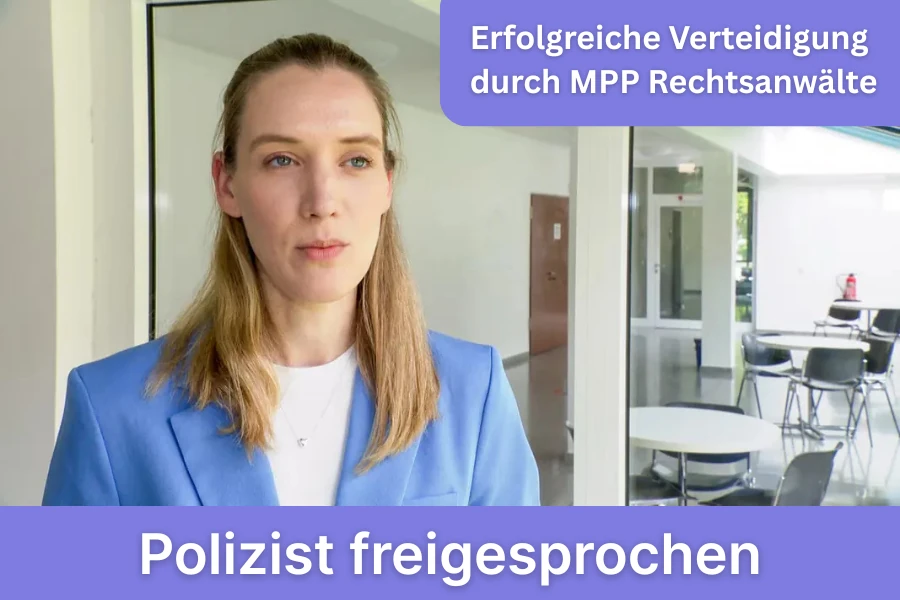
After nearly four years of legal dispute, the Göttingen Regional Court confirmed a landmark acquittal for a police officer in May 2025. The successful defense by Attorney Anthea Pitschel of MPP Rechtsanwälte impressively demonstrates the importance of competent criminal defense for police officers on duty.
The Case: Escalated Arrest with Far-Reaching Consequences
In July 2021, a momentous police operation took place in downtown Göttingen. A heavily intoxicated 31-year-old put up massive resistance against police measures. The police officer, now 35, felt compelled to restrain the aggressive man together with three colleagues. During the incident, blows were struck against the person being arrested—an event that was documented by bodycam footage and later published on the internet.
The public prosecutor’s office subsequently brought charges for assault while in office. A difficult time began for the officer involved: in addition to the criminal proceedings, he had to endure massive hostility and even felt forced to move away from Göttingen with his family.
Two Instances – Two Acquittals
First Acquittal at the Göttingen Local Court (2023)
The Göttingen Local Court had already concluded that the officer had acted in an extreme, exceptional situation. According to the officer’s statement, the person being arrested had gripped him so tightly that he could not breathe—he feared for his life. The court recognized that the officer may have exceeded the limits of self-defense “out of confusion, fear, or terror” (Section 33 of the German Criminal Code (StGB)) and acquitted him.
Confirmation by the Göttingen Regional Court (2025)
In the appeal proceedings, the Local Court’s assessment was not only confirmed but interpreted even more clearly in favor of the police officer. A police trainer from Hesse, brought in as an expert witness, attested that the defendant’s behavior was fully compliant with regulations. The blows were deemed proportionate as a means of police coercion to restore safety.
The Importance of Professional Criminal Defense
The case serves as a prime example of how vital specialized defense is for police officers. Attorney Anthea Pitschel of MPP Rechtsanwälte successfully led the defense through both instances. “It was very important for my client that his assessment of the situation is now also supported by the court,” she explained after the acquittal became final and binding.
The legal processing of such cases requires not only profound knowledge of criminal law but also a deep understanding of police operational situations and the legal framework of police action. It was precisely this expertise that MPP Rechtsanwälte was able to successfully contribute to this case.
JTNDaWZyYW1lJTIwd2lkdGglM0QlMjI0MDAlMjIlMjBoZWlnaHQlM0QlMjI2MDAlMjIlMjBzcmMlM0QlMjJodHRwcyUzQSUyRiUyRnd3dy55b3V0dWJlLmNvbSUyRmVtYmVkJTJGQ1BkblpuZDhaMDglM0ZzaSUzREd6VTFCUGE0QURHZ1NQQWUlMjIlMjB0aXRsZSUzRCUyMllvdVR1YmUlMjB2aWRlbyUyMHBsYXllciUyMiUyMGZyYW1lYm9yZGVyJTNEJTIyMCUyMiUyMGFsbG93JTNEJTIyYWNjZWxlcm9tZXRlciUzQiUyMGF1dG9wbGF5JTNCJTIwY2xpcGJvYXJkLXdyaXRlJTNCJTIwZW5jcnlwdGVkLW1lZGlhJTNCJTIwZ3lyb3Njb3BlJTNCJTIwcGljdHVyZS1pbi1waWN0dXJlJTNCJTIwd2ViLXNoYXJlJTIyJTIwcmVmZXJyZXJwb2xpY3klM0QlMjJzdHJpY3Qtb3JpZ2luLXdoZW4tY3Jvc3Mtb3JpZ2luJTIyJTIwYWxsb3dmdWxsc2NyZWVuJTNFJTNDJTJGaWZyYW1lJTNF
Impact of the Proceedings
The years of criminal proceedings left deep marks on the acquitted officer. In his closing statement before the court, he vividly described the burden on himself and his family. The media’s pre-judgment, the hostility, and the forced change of residence show the price police officers sometimes have to pay for the performance of their duties.
The officer no longer works in patrol duty today—a consequence that gives pause for thought when he himself asks: “Who would even want to do that anymore?”
Legal Classification: Self-Defense and Police Violence
The case raises important questions regarding the tension between necessary police force and the limits of the rule of law. The Regional Court made it clear: in extreme situations, blows can be a legitimate means of police coercion if all milder means have failed. This assessment was confirmed by the expert witness, who evaluated the measures as a step-by-step escalation.
The legal basis for this is Section 33 of the German Criminal Code (StGB), which regulates so-called excessive self-defense. This privileges individuals who, in a self-defense situation, exceed the limits of necessary defense out of confusion, fear, or terror. In the present case, the court recognized exactly this exceptional psychological situation for the accused officer, who, according to his own statement, felt a fear of death when he was being choked by the person being arrested.
Critical voices, such as that of criminal law expert Gunnar Duttge from the Georg-August University of Göttingen, warn against an overly broad interpretation of self-defense rights for police officers. His concerns are particularly directed at the fact that a higher resistance to stress can be expected from trained officers. This legal debate shows how complex the legal assessment of police action in extreme situations is and underscores the importance of expert defense in such proceedings.
Conclusion: An Important Signal for the Police
The final and binding acquittal sends an important signal to all police officers: those who act in exceptional situations while maintaining proportionality can rely on the protection of the rule of law—provided they have a competent defense at their side.
Consultation via Video Conference
Our attorneys provide personal consultations regardless of your location – via secure video conferencing, throughout Germany.
Schedule an Appointment
Ihr Kontakt zu uns
Schildern Sie uns Ihren Fall vertraulich
Schildern Sie kurz, was passiert ist und ob Fristen oder Termine laufen. Wir melden uns in der Regel innerhalb von 24 Stunden, um das weitere Vorgehen und die benötigten Unterlagen zu klären.
Call directly