
January 12, 2025
|
in Criminal Law
by Dr. Anthea Pitschel
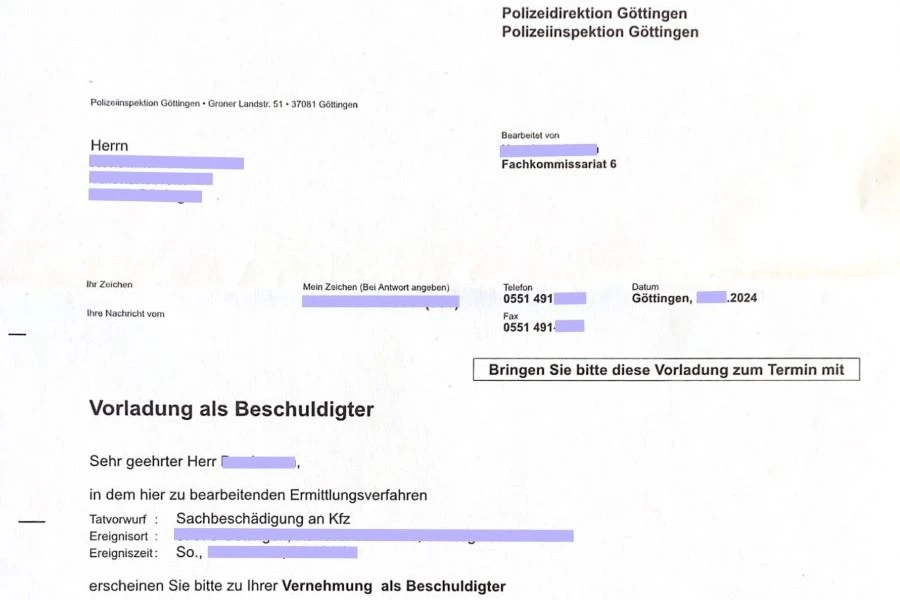
Summons for a criminal offense – what needs to be done?
Receiving such a summons as a suspect understandably and justifiably triggers immense feelings of stress and uncertainty. Unresolved questions revolve around the best way to respond, one’s own rights as a suspect, the right time to consult a criminal defense attorney, and the uncertainty of whether failing to appear for the summons fuels tendencies toward incrimination or seems advisable.
This article dispels several myths surrounding the rights of the suspect in connection with a police summons and highlights, in particular, the significant relevance of a criminal defense attorney at this stage of the proceedings.
Summons as a Suspect – The Essentials in Brief
A police summons as a suspect is stressful, but you have strong rights. Here are the most important points at a glance.
No Obligation to Appear:In the case of a police summons, you do not have to appear and do not even need to cancel the appointment.
Silence Protects:Remaining silent must not be interpreted negatively and prevents incriminating statements.
Hire a Lawyer:A criminal defense attorney will cancel the summons for you, request access to the case files, and develop the right strategy.
Do Not Go to the Police Alone – Even if Innocent:Well-intentioned explanations often cause more harm than silence.
Conclusion:First access the files, then decide – never go to the police unprepared.
Summons as a Suspect – What to Do?
A summons as a suspect understandably triggers significant feelings of stress and uncertainty.
Many of those affected do not know if they are allowed to ignore the summons, how to react correctly, or if a failure to appear has negative consequences.
Furthermore, it is often unclear what rights a suspect has, when one should absolutely involve a criminal defense attorney, and whether making a statement to the police is even useful.
This article dispels the typical myths surrounding the police summons as a suspect and explains step-by-step,
- what such a summons means,
- what rights you have,
- and how to conduct yourself optimally.
It also shows why the early involvement of a criminal defense attorney is crucial and, in many cases, prevents you from unnecessarily incriminating yourself or making mistakes that are difficult to correct later.
Received a police summons as a suspect – the essentials in brief
If you have received a police summons as a suspect, it is crucial to act quickly and strategically.
1. Contact a criminal defense attorney immediately
At the latest upon receipt of the summons, you should seek legal assistance.
2. You do not have to comply with the police summons
As a suspect, there is no obligation to appear at the police station. Communication should be handled exclusively through your defense attorney.
3. Silence is your strongest right
No adverse inferences may be drawn from your silence. Use this right before you say anything that could be used against you later.
4. Keep calm
A summons does not automatically mean an indictment. A criminal defense attorney can check whether reliable evidence already exists or whether a dismissal of the proceedings is possible.
Purpose and Procedure of a Suspect’s Summons
The police only summon you for an interrogation as a suspect if there is initial suspicion against you.
Despite a usually polite conversational atmosphere, you must not forget that investigative officers primarily want to gather evidence and obtain incriminating statements with a police summons.
How does a suspect interrogation proceed?
Typically, the interrogation follows a fixed pattern:
- Police Duty to Inform: Before the interrogation begins, you must be informed: that you are being investigated as a suspect, that you have the right to remain silent, and that you may consult a defense attorney at any time.
- Reference to Legal Counsel: Should you appear unprepared (which you should not), the police must explicitly point out your option to contact a criminal defense attorney.
- Reference to Further Rights: These include, among others: the right to file motions for evidence, the possibility of a court-appointed defense under §§ 140–142 StPO.
- Recording of the Interrogation: Every suspect interrogation is fully recorded. You have the right to review the transcript and correct ambiguities immediately.
- What happens next? You will find out at a later date from the public prosecutor’s office how the police evaluate your statements and how the proceedings will continue.
Important Note for Suspects
If you appear for the interrogation unprepared, you risk making ill-considered statements that can later be used against you.
The Rights of the Suspect in a Police Summons
A widespread misconception is that one must mandatory follow a police summons as a suspect.
Many of those affected believe that a failure to appear could be interpreted as an admission of guilt or that one must explain their innocence to steer the proceedings “in the right direction.”
In fact, the opposite is true: As a suspect, you do not have to appear for a police summons.
Why this misconception is dangerous
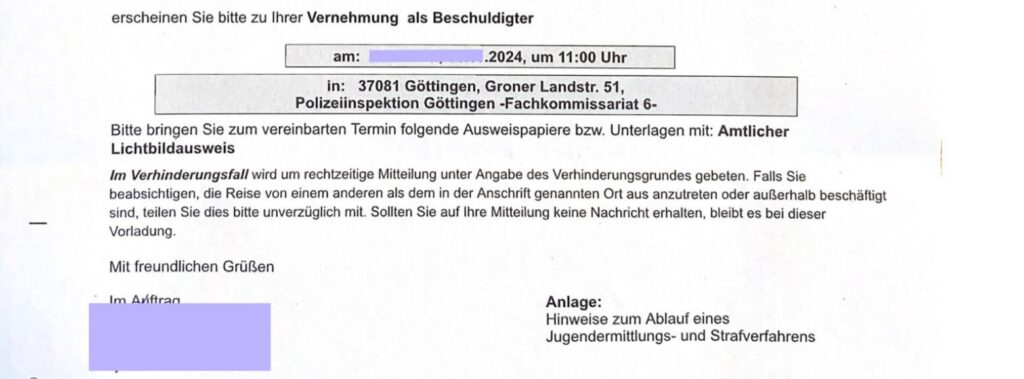
The police often point out in summonses that one should “notify by telephone” in case of inability to attend. This suggests an obligation – in fact, it does not exist.
This addition does not serve your protection, but rather makes it easier for the police to contact you and increases the likelihood that you will – consciously or unconsciously – make a statement anyway.
Staying away from the summons as your central right as a suspect
The legislator deliberately protects suspects by giving them the right to stay away from a police summons.
You do not have to give reasons.
You do not have to cancel.
Your silence or failure to appear must not be evaluated negatively. The police often use the erroneous assumption of an obligation to appear to their advantage. Those who appear without a defense attorney often say more than is good for them – especially in the case of summonses for property crimes such as fraud, embezzlement, or theft.
Canceling the summons – why you should never speak to the police yourself
If you nevertheless wish to cancel the summons, you should never communicate personally or by telephone with the police.
This avoids two risks:
- You begin to justify yourself, often without realizing it.
- The police try to convince you of the “advantages” of appearing, which is usually not in your interest.
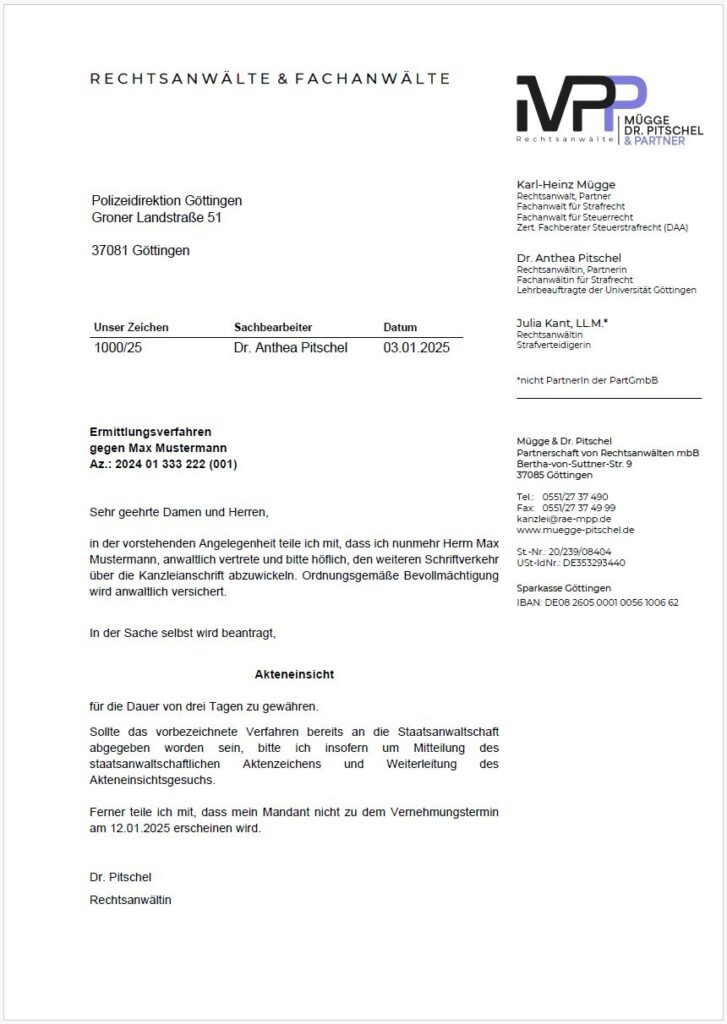
If the summons reaches us, we as your lawyer will take over:
- the informal cancellation,
- the application for access to the case files,
- the complete communication with the police.
You do not have to react, give no reasons, provide no information.
Silence is Golden and Your Strongest Protection
Your right to remain silent is one of the central rights in criminal proceedings.
Important to know:
- Silence may not be interpreted to your disadvantage.
- Even innocent people should remain silent until a lawyer knows the file.
- Silence protects you from misunderstandings and premature conclusions.
- Only the public prosecutor’s office decides on dismissal or indictment – not the police.
Why silence is so important:
Police interrogations are not neutral. Officers regularly want to uncover contradictions, test statements, or record comments that can later be interpreted as incriminating.
Especially those who feel innocent run the risk of saying things that can later be used against them.
Therefore:
Silence first. Then access to files. Then legal strategy.
The Tasks of the Criminal Defense Attorney – Equality of Arms & Strategy
Our task as experienced criminal defense attorneys is to secure your rights early on and develop an effective defense strategy.
Ideally, you should contact us immediately after receiving a summons as a suspect.
This allows us to take over all communication with the police or public prosecutor’s office from the start – including:
- Cancellation of the police summons,
- Application for access to the case files,
- Legal assessment of the allegations against you,
- Strategy planning without the risk of premature statements.
Participation in an Interrogation – Only After Reviewing the Files
Should the detailed examination of your investigation file show that a statement could be useful, we will prepare you comprehensively and accompany you to the interrogation upon request.
Goal of the Defense: Dismissal Instead of Indictment
If the state of the files permits, our top priority is the dismissal of the proceedings according to § 170 StPO.
If the evidence does not allow for this, we develop a tailor-made defense strategy for the main proceedings and stand reliably by your side in all stages of the process.
Why Early Legal Help is Crucial
The earlier you involve a specialized criminal defense attorney, the better we can:
- uphold your rights as a suspect,
- avoid wrong decisions (e.g., premature statements),
- keep the investigative authorities within their bounds,
- secure or invalidate evidence.
You not only save time and nerves but also significantly strengthen your position in the preliminary investigation.
Consultation via Video Conference
Our attorneys provide personal consultations regardless of your location – via secure video conferencing, throughout Germany.
Schedule an Appointment
Ihr Kontakt zu uns
Schildern Sie uns Ihren Fall vertraulich
Schildern Sie kurz, was passiert ist und ob Fristen oder Termine laufen. Wir melden uns in der Regel innerhalb von 24 Stunden, um das weitere Vorgehen und die benötigten Unterlagen zu klären.
Call directly