

July 23, 2025
|
in Criminal Law
in Tax Law
by Dr. Anthea Pitschel
Tax Evasion in Fast Food & Snack Stands – Key Points at a Glance
- Type of business: Snack bars and fast food establishments with cash sales are particularly frequent targets of unannounced cash register audits and tax investigations.
- Common deficiencies: Non-certified point-of-sale systems, missing Z-reports, or open cash drawers raise suspicion.
- Risk: Faulty or incomplete cash bookkeeping frequently leads to estimated assessments, back taxes, and criminal proceedings.
- Manipulation: Programs such as “zappers” or fictitious operators (“training waiters”) are technically easy to deploy. Their use is criminally prosecuted.
- Defense: We represent clients nationwide, swiftly, and discreetly, with a dedicated specialization in criminal tax law.
Tax Evasion in Fast Food & Snack Stands – Cash Sales, Cash Accounting & Legal Defense
Has the tax office contacted you? Whether it is a search, a hearing, or a formal letter: prompt action is crucial now. Many of our clients come to us when preliminary proceedings are already underway. In this article, you will learn what steps you should take now and how we can effectively defend you.
Criminal proceedings frequently begin with an unannounced cash register audit or suspicion of incompletely recorded cash transactions in a fast food operation.

Typical Real-World Scenario
The operator of a doner kebab shop sells on a cash-only basis each day, does not maintain a certified electronic cash register, and accounts for sales using lump-sum Z-reports. Revenues do not align with the cost of goods sold or bank balances. An anonymous tip leads to an unannounced cash audit, followed by a search of premises based on the suspicion of tax evasion.
Formal deficiencies in cash bookkeeping authorize the tax office to issue an estimated assessment pursuant to Section 162 of the German Fiscal Code (AO).
Why Fast Food and Snack Businesses Are Frequently Targeted
Whether doner kebab stands, Asian snack bars, pizzerias, kiosks, or bars—all cash-intensive businesses quickly draw the attention of the tax fraud investigation office. Audit practices follow a familiar pattern: as soon as formal defects in cash bookkeeping accumulate, an estimated assessment or even formal criminal proceedings generally ensue.
Typical formal accounting defects include:
- Missing or inadequate cash record-keeping
- Failure to implement single-transaction recording requirements
- Missing Z-reports, deletion logs, or non-certified POS systems
- Cost of goods sold does not match reported revenue
All of these are classic indicators used by the tax authorities to justify an estimated assessment or a criminal tax evaluation.
These formal accounting deficiencies are often sufficient to establish the authority to estimate under Section 162 AO or to initiate preliminary proceedings for tax evasion.
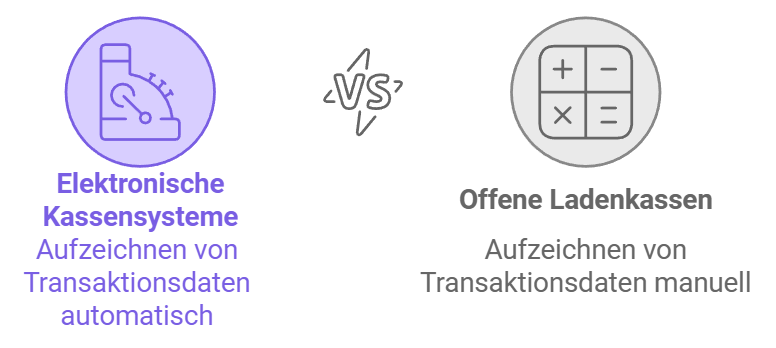
The use of open cash drawers, where no single-transaction records or certified security devices exist, is particularly problematic. In practice, this frequently leads to objections by the tax office—especially when no certified cash register is used.
What Are the Consequences of Tax Evasion in Fast Food Businesses?
Manipulations via “zappers” or “training waiters”? Some POS systems can be manipulated through secondary features, such as fictitious staff profiles (“training waiters”) or specialized software (“zappers”) that delete sales data. In severe cases, criminal liability under Section 283 of the German Criminal Code (StGB) (violation of bookkeeping duties) may also apply.
| Issue | Potential Consequence |
| No Z-report saved | Authority to estimate under Section 162 AO |
| POS system not certified | Violation of the German Cash Security Ordinance (KassenSichV) |
| Cash sales unrecorded | Tax evasion under Section 370 AO |
| Cash register data deleted or incomplete | Initial suspicion of intentional tax evasion |
| Cost of goods sold not plausible | Estimated assessment by tax audit |
Additional risks:
- Fines or imprisonment (depending, e.g., on the amount of evaded tax)
- Estimated assessments and tax arrears, including evasion interest (Section 235 AO)
- Preliminary proceedings, search of premises, asset seizures and account freezes
Engage a certified specialist attorney now – we know how fast food audits work
Specialized in demanding and complex proceedings. We defend you discreetly & nationwide.
How we secure your defense, even if proceedings are already underway
- Immediate assessment of the procedural status—whether summons, search, or formal hearing
- In-depth review of cash management, receipts, cost of goods, and accounting records
- Criminal defense against the tax office, tax fraud investigators, and public prosecutor’s office
- Close collaboration with tax advisors for retroactive corrections and declarations
Preliminary Proceedings Underway: What to Do Now
If the tax office has already taken action, every minute counts. At that stage, voluntary disclosure to obtain immunity is no longer available. What matters now is a thorough evaluation of cash accounting and experienced criminal defense. We analyze your documentation, prepare your legal defense, and liaise directly with investigative authorities.
Why Choose Us?
- Over 1,000 criminal tax cases defended nationwide
- Specialized in hospitality and cash-intensive business matters
- Collaboration with tax experts and POS system specialists
- Rapid response, discreet, and assertive
Frequently Asked Questions Regarding Ongoing Tax Evasion Proceedings in Food Stands and Snack Bars
How should I respond to a summons from the tax office?
Remain calm, make no statement regarding the allegations, and request prior consultation with legal counsel.
What happens during a search of a food stand or snack business?
Tax fraud investigators will seize cash registers, receipts, and computer equipment. Do not be intimidated, exercise your right to remain silent, and contact us immediately.
Are there common mistakes made in legal defense?
Yes: premature statements, uncoordinated submission of documents, or proceeding without inspecting the case file. We secure your defense systematically.
How does the tax office discover unreported sales?
Through unannounced cash register audits, control notifications, supplier inquiries, or tips from third parties.
Can an estimated assessment be issued without a full tax audit?
Yes. In the event of formal deficiencies in cash bookkeeping, the tax office is permitted to estimate.
How far back can proceedings extend?
Generally, the statute of limitations for criminal tax prosecution ranges from five to ten years.
What is the benefit of a voluntary disclosure?
If submitted in a timely and comprehensive manner, it can result in full immunity from prosecution—we will evaluate this for you.
How quickly must I act?
Immediately: with each passing day, the risk increases that legal grounds disqualifying an effective voluntary disclosure will arise.
Consultation via Video Conference
Our attorneys provide personal consultations regardless of your location – via secure video conferencing, throughout Germany.
Schedule an Appointment
Ihr Kontakt zu uns
Schildern Sie uns Ihren Fall vertraulich
Schildern Sie kurz, was passiert ist und ob Fristen oder Termine laufen. Wir melden uns in der Regel innerhalb von 24 Stunden, um das weitere Vorgehen und die benötigten Unterlagen zu klären.
Call directly