


Key facts regarding Insult under Section 185 StGB
Official English Translation: Section 185 of the German Criminal Code is officially translated as “Insult”. The statutory wording is brief, so the legal assessment largely depends on the specific context and the applicable German case law.
Legal Definition: Insult is an attack on another person’s honour through the expression of disrespect or contempt. It may be committed through spoken or written words, gestures, images, or other conduct.
Penalties: A simple insult is punishable by a fine or imprisonment for up to one year. If the insult is committed publicly, at a gathering, by disseminating content, or by means of an assault, the maximum term of imprisonment is two years. Under Section 188 StGB, insults directed at persons in political life may be punishable by imprisonment for up to three years.
Prosecution upon Request: As a rule, insult is prosecuted only if the injured person files a criminal complaint within the applicable time limit. Exceptions may apply where the prosecution authorities consider intervention necessary due to a particular public interest.
Police Summons: A defendant has the right to remain silent and is generally not required to attend a police interview. A criminal defence lawyer can request access to the investigation file, assess the evidence, and develop an appropriate defence strategy.
A brief look at the world is enough to find insults across various social classes with different objectives, directed at diverse recipients, and in various forms. The insults uttered range from slurs such as “asshole” or “slut” to homophobically or transphobically motivated remarks like “gay pig” or “fucking tranny.”
Politicians in particular are frequently victims of the contempt of individuals.
For instance, a pensioner from Göttingen recently made headlines when he shouted “Filthy lot, you Greens!” at a female politician from the Green Party at the end of May 2024.
Politically motivated insults are also rampant on social media and are found in the broader political landscape – Angela Merkel was no more immune to being called a “stupid bitch” by a Facebook user in 2021 than Jens Spahn was to being told “Piss off, you gay wanker, you gay pig.”
In this context, a classic example of insulting a politician is the discontinued proceedings regarding Jan Böhmermann’s “Abusive Poem” against Turkish President Erdogan.
Furthermore, the police are a popular target for insults nationwide. The “ACAB” insult (“All cops are bastards“, literally “Alle Polizisten sind Bastarde“) is a perennial issue. Being greeted as a “club of racists” even represents a relatively “mild” insult in view of the extensive case law regarding insults against police officers.
The Statutory Elements of Section 185 StGB
From an objective perspective, the offense of insult under Section 185 StGB requires an object capable of being insulted and a suitable act of commission. Initially, any living human being is considered capable of being insulted. Theoretical and – given the frequency of these cases – practical problems revolve around the capacity of groups of persons to be insulted. In this regard, a distinction must be made between insult under a collective designation and collective insult. For the former, it is required that the affected group of persons stands out clearly from the general public, is clearly determinable due to its manageable size, and that the individual person can be assigned to this group. Examples include soldiers of the Bundeswehr or – given their specific history in Germany – “the Jews” as a definable group of persons. In contrast, a collective insult refers to the insult of a collective entity. Such an entity is capable of being insulted if it fulfills a recognized social function, can form a unified will, and is independent of changes in its membership. The capacity of authorities and public bodies to be insulted is specifically regulated in Section 194 (3) and (4) StGB. In addition to this object capable of being insulted, there must objectively be an insult as a suitable act of commission. This is generally understood as an attack on the honor of another person by expressing one’s own disregard or contempt. This expression-based offense is thus directed against a core area of human dignity protected by Article 1 of the Basic Law (GG). Contempt can be expressed toward the object of the crime within the meaning of Section 185 StGB in various ways: The insult can occur through an insulting value judgment toward the person concerned or a third party, or through an insulting, untrue statement of fact toward the person concerned. In the latter case, the untruth of the statement of fact becomes an objective element of the offense. Written, oral, or implied actions (for example, through gestures) can suffice to express an insult and thus satisfy the character of insult as an expression-based offense. Subjectively, insult under Section 185 StGB requires intentional action. The perpetrator must have acted consciously and willfully to fulfill the requirements of the objective elements of the offense. It is sufficient that the expression of contempt is included in their intent. A specific intent to insult is not required. The second alternative of Section 185 StGB constitutes a qualified form of insult: insult by physical assault. In this case, the insult occurs by means of a physical act if an action is taken that directly affects the victim’s body and involves a particular disregard or contempt for the honor of the person concerned. Typical examples include cases where the victim is spat upon by the perpetrator or struck in a degrading context. Essential for the simple case of insult under Section 185 StGB is its character as an absolute complaint-based offense (Section 194 (1) StGB). Accordingly, criminal prosecution is initiated exclusively upon application, Sections 77 et seq. StGB. Several special forms of insult are regulated in the 14th section of the StGB. In this context, reference should be made to insults directed at persons in political life under Section 188 StGB, the disparagement of the memory of deceased persons under Section 189 StGB, and the inciting insult regulated in Section 192a StGB. A significantly defamatory statement can thus trigger the elements of Section 188 StGB – for example, calling Angela Merkel a “stupid bitch” on Facebook can be classified under this criminal offense.What is the penalty for insult?
For a simple insult under Section 185 StGB, the potential sentencing range is between a fine and imprisonment for up to one year. The penalty is increased to a potential prison sentence of up to two years if the insult is committed publicly, in a meeting, by disseminating content (Section 11 (3) StGB), or by means of a physical assault, Section 185 Alt. 2 StGB. Some special forms of insult have a sentencing range corresponding to insult by physical assault under Section 185 Alt. 2 StGB, or in some cases even an increased penalty. While the disparagement of the memory of deceased persons under Section 189 StGB and inciting insult under Section 192a StGB also offer a sentencing range from a fine to two years’ imprisonment, an insult directed at persons in political life under Section 188 StGB can even result in a prison sentence of up to three years.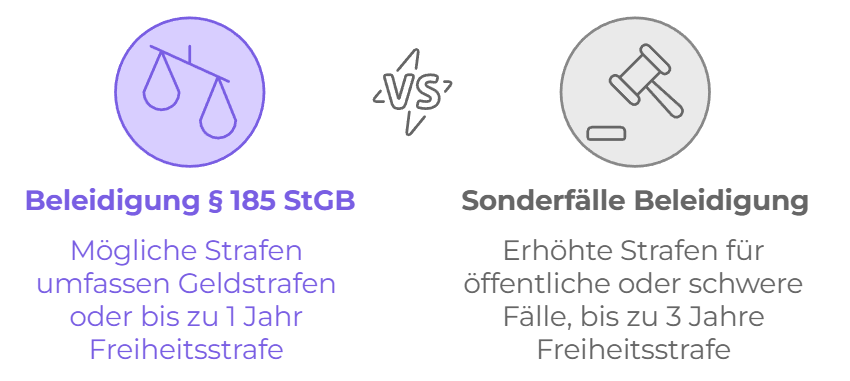
Do I need a lawyer?
If you have received a police summons for an insult under Section 185 Alt. 1 StGB or for an insult by means of physical assault under Section 185 Alt. 2 StGB, please first remain calm in your own interest. As a defendant in investigative proceedings for insult under Section 185 StGB, you are not obliged to provide statements to the police. Even if an insult may seem like a trivial matter at first glance, you should not underestimate the allegation – insult is also a criminal offense and can be punished under criminal law accordingly. A legal assessment and consultation by a lawyer familiar with insult offenses can therefore alleviate initial uncertainties and outline a clear course of action for your specific case. Judgments in insult cases are often issued in writing via a penal order. It is possible to file an objection within 14 days of service. Targeted criminal defense can often result in a dismissal of the proceedings. A dismissal is particularly important for individuals in sensitive professional groups such as civil servants, public service employees, doctors, teachers, or lawyers, as a conviction could jeopardize their professional future. Potential secondary penalties as well as a prison sentence of up to one year, depending on the severity of the insult, should also not be underestimated. To counteract a higher sentence or, in the best case, to prevent a conviction, it is advisable for a defendant in criminal proceedings for insult to seek effective support from a specialized lawyer. Take the allegation of insult seriously – even if in your case it does not coincide with other offenses such as bodily harm or threats, you may have a criminal record after a conviction for insult. Avoiding these consequences is the primary goal of the defense. Therefore, take action in good time to ensure that your representation in court is guaranteed in the best possible way by an experienced criminal defense lawyer.Contact us now
Should you have further questions or be a defendant in criminal proceedings, please feel free to contact us.