

August 25, 2024
|
in Criminal Law
by Dr. Anthea Pitschel
Key Takeaways Regarding the Allegation of Fraud
- Definition of fraud: Fraud occurs when deception causes a misconception for the victim, resulting in financial loss. The perpetrator must act with the intent to unlawfully enrich themselves or a third party.
- Special forms of fraud: Common special cases include contractual fraud, employment fraud, social benefit fraud, and insurance fraud. In addition, there are distinct statutory offenses such as computer fraud or subsidy fraud.
- Penalties: Fraud carries fines or prison sentences of up to five years. In especially serious cases, the sentence can be increased to up to ten years.
- Entry in the certificate of conduct: Under certain circumstances, a conviction may be entered into the certificate of conduct (criminal record), which can have adverse consequences for employment opportunities.
- Legal representation: Specialized legal counsel is crucial to reducing penalties or securing a dismissal of the proceedings, thereby avoiding a trial.
How should you handle allegations of fraud?
Have you received a criminal complaint or a police summons for fraud under Section 263 of the German Criminal Code (StGB) and are unsure how to proceed?
First and foremost: stay calm, make no statements to the police, and exercise your right to remain silent—because that is your absolute right as a defendant in an investigation for fraud.
Fraud – When are the statutory elements of Section 263 StGB fulfilled?
Fraud under Section 263 (1) StGB objectively occurs when deception by the perpetrator leads to an erroneous belief on the part of the victim, which in turn causes a disposition of assets that results in financial damage. Subjectively, the perpetrator must act intentionally and with the intent to unlawfully enrich themselves or a third party.
Special forms & distinct statutory offenses of fraud
Fraud under Section 263 StGB frequently appears in the following special forms:
- Contractual fraud: Contractual fraud occurs when a debtor deceives a creditor regarding their intention to pay for purchased goods, despite already being neither willing nor able to pay at the time of purchase. Contractual fraud increasingly occurs in transactions via classified ad platforms (such as eBay Kleinanzeigen), mail-order retailers, or food delivery orders.
- Employment fraud: In the case of employment fraud, the offender fraudulently obtains a public service position by providing false information. Perpetrators often deceive regarding relevant qualifications, academic degrees, or personal circumstances.
- Welfare fraud (colloquially “Hartz IV fraud”): Welfare fraud may occur when relevant information is withheld from social welfare authorities (such as the Jobcenter or student financial aid offices/BAföG), thereby fraudulently obtaining benefits such as unemployment benefit I, citizen’s benefit (Bürgergeld), or housing benefit.
- Insurance fraud: Any person who asserts a non-existent claim for insurance benefits against their insurance provider commits a criminal offense. This is the case, for example, when an item is reported stolen even though it is still in the policyholder’s possession, or when the policyholder intentionally stages a vehicle collision to claim fictional repair costs based on an expert appraisal.
Furthermore, the following distinct statutory offenses related to fraud exist:
Computer fraud under Section 263a StGB, subsidy fraud under Section 264 StGB, investment fraud under Section 264a StGB, insurance abuse under Section 265 StGB, credit fraud under Section 265b StGB, fraudulently obtaining services under Section 265a StGB, and sports betting fraud under Section 265c StGB.
What penalties can I expect in the event of a conviction?
Sentences for fraud range from fines to up to five years of imprisonment. In especially serious cases of fraud under Section 263 (3) StGB, potential penalties extend to prison terms ranging from six months to ten years.
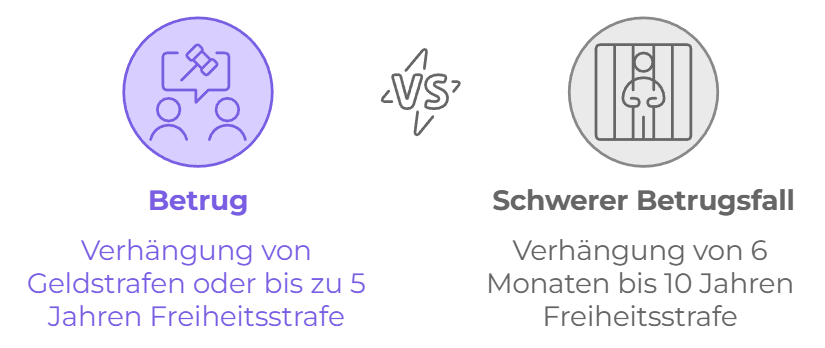
The specific penalty in an individual case depends primarily on the amount of financial loss incurred as well as any prior criminal record of the accused (especially relevant past offenses).
In addition, there is the risk of an entry in your certificate of conduct. As a general rule, a conviction of up to and including 90 daily fine units (Tagessätze) does not have to be listed, provided it is a first-time conviction. Because many employers require the submission of a certificate of conduct, defense counsel must take this factor into account and, ideally, prevent an entry in your record.
Legal consultation – When do I need a criminal defense attorney?
To minimize the penalty or avoid a conviction altogether, assistance from a qualified specialist is essential whenever you are facing criminal proceedings for fraud.
The statutory offense of fraud is highly complex and, because even experienced legal professionals can make mistakes in this area, it provides many strategic opportunities for a successful defense.
You should therefore contact a lawyer specializing in criminal law no later than when you receive a summons as an accused person. Your attorney can advise you on potential defense strategies and, in the best case, achieve a dismissal of the proceedings so that you do not have to face a trial in court.
The law firm Mügge, Dr. Pitschel & Partneradvises and defends clients with years of experience across numerous fraud proceedings. We would be pleased to evaluate whether a dismissal of the proceedings is feasible in your case and can be achieved through focused legal advice and criminal defense.
Fraud in commercial criminal law and corporate criminal law
If you are an entrepreneur or managing director of a company and are accused of committing fraud, you should handle this suspicion and any potential investigation with utmost caution.
Allegations often arise when business owners have claimed public funds (subsidies), tax relief, or loans and are alleged to have provided false or incomplete information in their application, or when the funds obtained were allegedly used for unauthorized purposes.
Consultation via Video Conference
Our attorneys provide personal consultations regardless of your location – via secure video conferencing, throughout Germany.
Schedule an Appointment
Ihr Kontakt zu uns
Schildern Sie uns Ihren Fall vertraulich
Schildern Sie kurz, was passiert ist und ob Fristen oder Termine laufen. Wir melden uns in der Regel innerhalb von 24 Stunden, um das weitere Vorgehen und die benötigten Unterlagen zu klären.
Call directly