


Bogus invoices – Key facts at a glance
Bogus invoices: These simulate services or disguise actual business transactions – usually for a tax advantage.
Objective: Unlawful deduction of business expenses and input tax without any actual provision of services.
Typical variants: Actual bogus invoices, cover invoices, straw man invoices, courtesy invoices, contracts with close relatives.
Legal basis: § 42 AO – Sham transactions are disregarded for tax purposes; the underlying concealed transaction is decisive.
Consequences: Tax corrections, interest payments, late filing surcharges, and potential criminal proceedings for tax evasion (§ 370 AO).
Criminal risk: Even mere participation or aiding and abetting can be punishable.
Our law firm: Defends nationwide against allegations involving bogus invoices – discreet, experienced, and specialized in tax and white-collar criminal law.
When the tax office suddenly suspects bogus invoices
Many entrepreneurs, whether in the construction industry, gastronomy, hairdressing, or the service sector, experience it sooner or later: a letter from the tax office, with the suspicion of tax evasion in the air. The allegation: the use or issuance of bogus invoices.
What initially begins harmlessly as a “bookkeeping problem” can quickly turn into an existence-threatening tax criminal proceeding. This often involves alleged services that were never rendered and invoices that, according to the tax office, only exist on paper.
The core of the allegation faced by restaurant operators, hair salon owners, construction contractors, and others is often the tax authority’s assumption that a service from an allegedly performing entrepreneur to an invoice recipient was simulated and that no service was actually provided.
Further allegations focus on the suspicion that the entrepreneur paid employees under the table and then had another company issue bogus invoices in order to claim business expenses.
We explain what bogus invoices are, what forms exist, what tax and criminal consequences may arise, and how you can effectively defend yourself.
Allegation of bogus invoices?
Proceedings underway? We are among the leading law firms for tax criminal law – get a strong defense nationwide now.
What are bogus invoices?
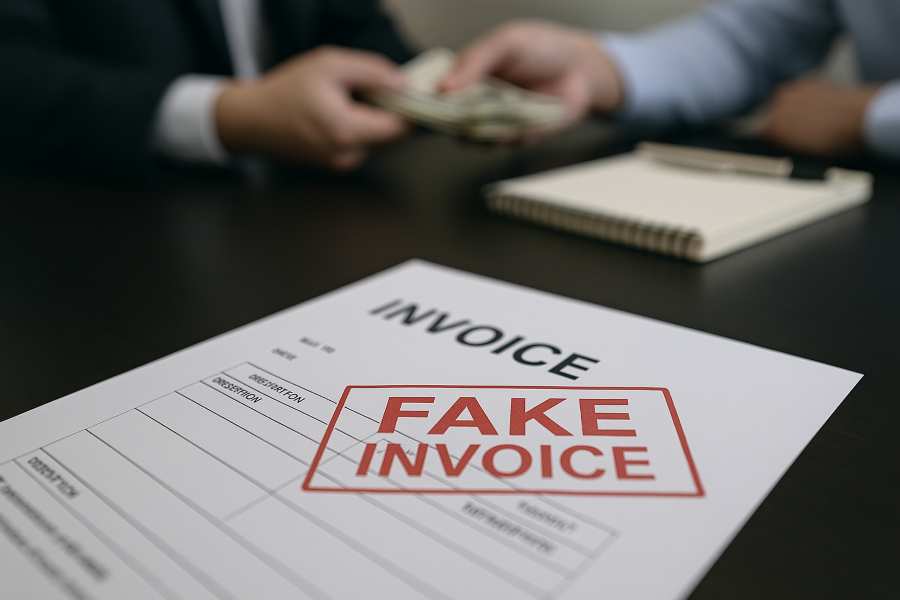
Bogus invoices are invoices that disguise an actual business transaction or are completely fabricated – with the aim of saving taxes or evading them. Frequently affected are:
-
- Value added tax
-
- Income tax
-
- Trade tax
-
- Corporate income tax
Both the issuer of the invoice and the recipient of the invoice can be prosecuted for the use of bogus invoices.
Typical types of bogus invoices
1. Actual bogus invoices
One company issues an invoice to another company without any exchange of services taking place, so that the invoice recipient can unlawfully claim the deduction of business expenses and input tax.
2. Evasive transactions
An invoice is issued to conceal another transaction, e.g., the payment of bribes.
3. Concealed transactions
An exchange of services occurs between two persons, but it is different from what is stated in the invoice, e.g., to achieve more favorable taxation.
4. Cover invoices
A classic example of this is an entrepreneur paying employees’ wages under the table, meaning they cannot claim business expenses. To compensate for this disadvantage, they commission another company to issue invoices for sham services. The invoice recipient can then deduct the fictitious invoice as a business expense and additionally claim the input tax deduction.
5. Straw man invoices
An invoice is issued that specifies a false invoice issuer or recipient. In this case, the false issuer or recipient merely serves as a straw man for the company actually providing the service.
6. Contracts with close relatives
For example, the entrepreneur employs their spouse, who allegedly handles the bookkeeping, or the self-employed person rents rooms from relatives and claims them as a business expense. In these cases, it must be checked using the so-called arm’s length principle whether an employment or rental relationship actually exists.
7. Courtesy invoices
The issued invoice contains a service that was not rendered or is inflated, e.g., to provide a business partner with an advantage or to assist them.
8. Forged invoices
An invoice is issued containing a forged signature, date, invoice number, or other false information, e.g., to justify or avoid an earlier or later payment.
Warning signs for the tax office regarding bogus invoices
This table shows typical conspicuous features that alert the tax office. The table provides a rough overview of which irregularities tax offices investigate:
| Irregularity | Possible assessment by the tax office |
|---|---|
| Unusually high business expenses | Suspicion of bogus invoices to reduce profits |
| Repeated invoices from a “new” supplier | Suspicion of a shell company or straw man construction |
| No proof of actual service | Indication of a lack of exchange of services |
| Cash payment despite large amounts | Suspicion of concealing undeclared money |
| Relationship between contracting parties | Review for arm’s length principle (sham contracts among relatives) |
§ 42 AO: What the law says about bogus invoices
“Sham transactions and sham acts are irrelevant for taxation. If a sham transaction conceals another legal transaction, the concealed legal transaction is decisive for taxation.”
— § 42 para. 2 Fiscal Code (AO)
The consequence: Input tax deduction and business expense deduction are cancelled. The tax office can amend all tax assessments – often retroactively over several years.
What penalties apply to bogus invoices?
If the allegation is confirmed, drastic consequences follow:
-
- Tax back payments (often with 6% interest per year)
-
- Late filing surcharges and fines
-
- Criminal proceedings for tax evasion (§ 370 AO)
-
- Sentencing: Fine up to imprisonment
-
- Loss of reputation & exclusion from public contracts
It becomes particularly critical if the tax investigation department is already involved. In that case, you should seek legal assistance immediately before unintentionally incriminating yourself.
How we defend you – discreetly & effectively
Our law firm Mügge, Dr. Pitschel & Partner specializes in tax law and criminal law. We know how tax offices and criminal authorities proceed with bogus invoices and how to professionally fend off such attacks.
Our services:
-
- Review of invoices & contracts for plausibility
-
- Representation before the tax office, tax investigation department & public prosecutor’s office
-
- Defense in tax criminal proceedings
-
- Advice on voluntary self-disclosures to avoid penalties
-
- Avoidance of imprisonment and entry in the criminal record